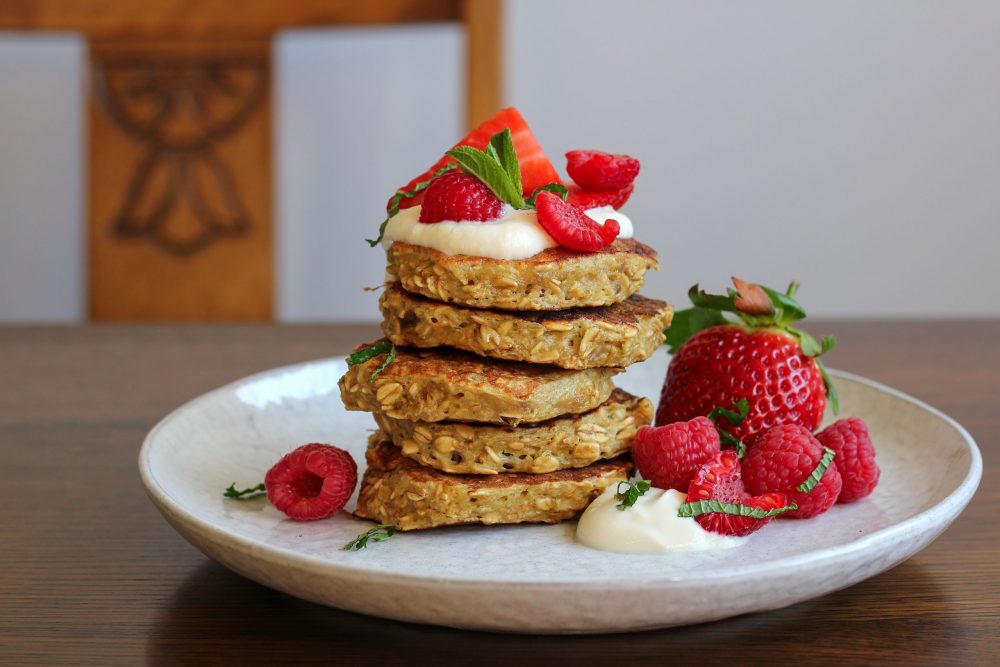
A delicious and easy way to start the day. Perfect for Pancake Day, or make a stash for on the go. Naturally sweet from the banana, these have no added sugar. You could further flavour the pancakes with fruits such as blueberries, or use dark chocolate chips for an extra sweet kick.
Use gluten-free oats to make this gluten-free, or dairy-free by using a milk alternative and yoghurt alternative (I have used soya products in this recipe).
Porridge Pancakes
Serves 2
Ingredients
1 large banana
1 egg
100g rolled oats
50ml milk of choice
1/2 tsp baking powder
1/2 tsp cinnamon (optional)
Oil for frying
To serve
150g strawberries
80g raspberries
160g yoghurt (I have used soya yoghurt)
A few mint leaves
Method
Mash the banana in a bowl with a fork till you have very small lumps.
Add the remaining ingredients, except for the oil, and mix well.
Heat a frying pan over a low heat.
Wipe 1/4 tsp of oil around the pan before adding spoonfuls of the mixture, spaced out. You should be able to make 6-8 pancakes from the batter.
Cook for 2 minutes, before flipping and cooking for a further 2 minutes.
Serve in stacks with yoghurt, berries and mint.
Delicious served with fruit and yoghurt
Per serving*: 430kcal/ 11g fat/ 1.9g saturated fat/ 60g carbohydrates/ 12g fibre/ 15g protein
*Analysis based on unsweetened soya milk and unsweetened soya yoghurt
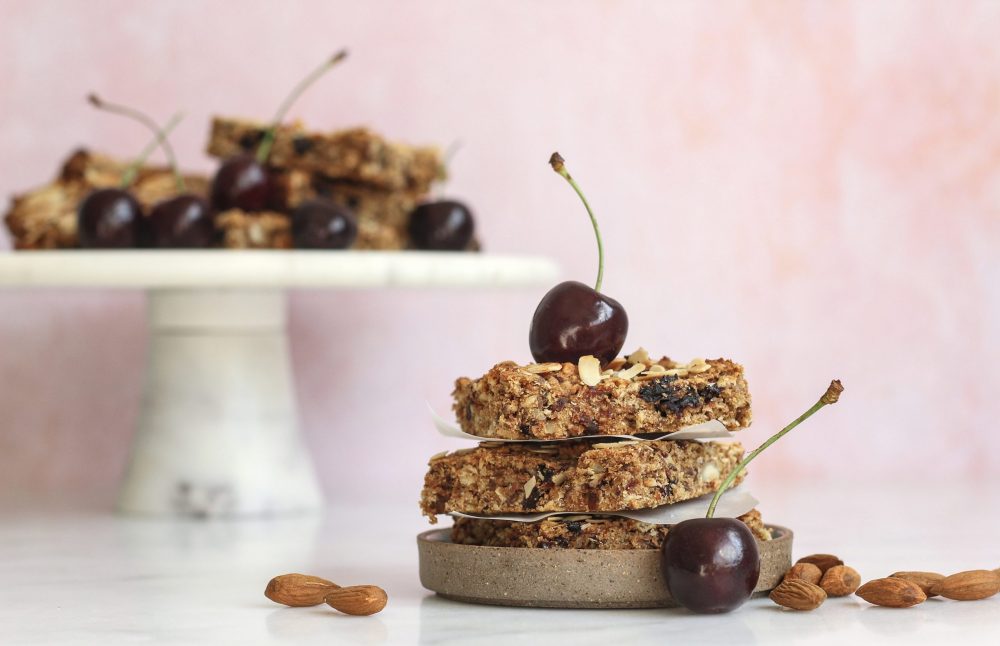
Get a head start on the week by whipping up a batch of my Bakewell Breakfast Bars. Naturally sweetened using dates and cherries, these bars contain no added sugar. They also pack some wholesome goodness in the form of oats and wholemeal flour meaning they contain 5.5g of fibre per bar as well as some healthy fats from the seeds and nuts.
If you don’t have cherries you can substitute in other dried fruits such as apricots, raisins, sultanas or even blueberries – just watch out that the dried fruits don’t contain added sweeteners such as glucose or apple juice. You can also swap the almonds and almond butter for other nuts or nut butter, or top with coconut chips.
These are great for on-the-go in the morning or as an afternoon snack. Keep in an airtight Tupperware container for 4-5 days or alternatively freeze them for longer-term storage.
Makes 9 squares
Ingredients
100g pitted dates
25g linseeds
60g dried unsweetened cherries
50g skin-on almonds
75g butter or vegan butter
25g almond butter
100g wholemeal flour
100g oats
15g sliced almonds
Method
Preheat the oven to 180°C and line a 25x25cm baking tin with baking parchment.
Soak the pitted dates in 50ml boiling water and the linseeds in 50ml tap water for 5 minutes.
Meanwhile, roughly chop the almonds and cherries by hand or using a food processor. If using a food processor remove once chopped.
After the dates have soaked for 5 minutes transfer them to the food processor and blitz to a paste*
Add the butter, almond butter and soaked linseeds with the water and blend together.
Add the flour to form a sticky dough.
Add the oats and chopped almonds and cherries and pulse until it just comes together. If you want a smoother consistency pulse for longer.
Press into the lined tin and top with flaked almonds before baking for 20 minutes.
Remove from the oven and allow to cool before slicing.
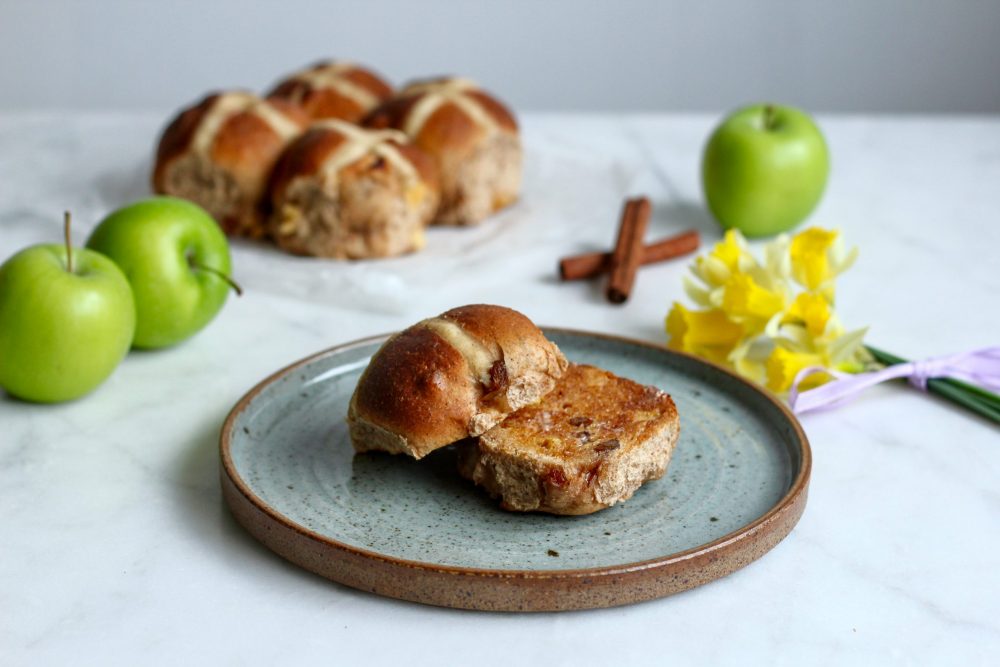
Best of both Apple and Cinnamon Hot Cross Buns combining the goodness of wholemeal flour with sweet cinnamon and apple to give a delicious but healthy twist to this Easter classic. This recipe is adapted from Julie Jones‘s Soulful Baker cookbook.
Makes 9 buns
Ingredients
For the buns
50g butter, melted
175g strong white flour
175g strong wholemeal flour
35g caster sugar
1 tsp ground mixed spice
2 tsp ground cinnamon
7g fast action yeast
Up to 160ml tepid water
1 egg
50g sultanas
50g dried apple, roughly chopped
For the crosses
10g butter
40g strong white flour
45ml water
For the glaze
75ml water
1 tbsp sugar
1 large pinch cinnamon
1 large pinch ground mixed spice
Method
Add all the dried ingredients for the buns, except the fruit, into a stand mixer. Add the butter, egg and 150ml water.
Mix on a low speed for 10 minutes, adding the remaining 10ml of water if the dough looks a little dry – it should be just sticky.
After 10 minutes add the dried fruit and mix for a further 2 minutes till incorporated.
Form into a ball, cover, and allow to rise till doubled in size for around 1.5 hours.
Once the dough has doubled in size, knock it back and divide the ball into 9 equal pieces.
Roll each piece into a tight ball without any fruit sticking out the top as these will burn.
Place the balls in a 3×3 formation in a baking tin roughly 20cmx20cm lined with baking parchment.
Cover and allow to prove for 30 minutes.
Preheat the oven to 200°C fan.
Melt the butter for the crosses and then whisk in the flour and water to make a thick pipe-able paste. Transfer into a piping bag and snip the end to make a small hole.
Pipe crosses (or whatever you fancy) across the tops of the buns.
Bake in the oven for 15 minutes till golden brown.
Meanwhile, in a saucepan, heat the water, sugar and spices to make the glaze.
Once the buns are cooker, immediately brush with the glaze.
Transfer to a wire rack, remove the baking parchment and allow to cool.
Per bun: 256kcal/ 6.6g fat/ 3.6g saturated fat/ 40.0g carbohydrates/ 5.2g fibre/ 7.8g protein
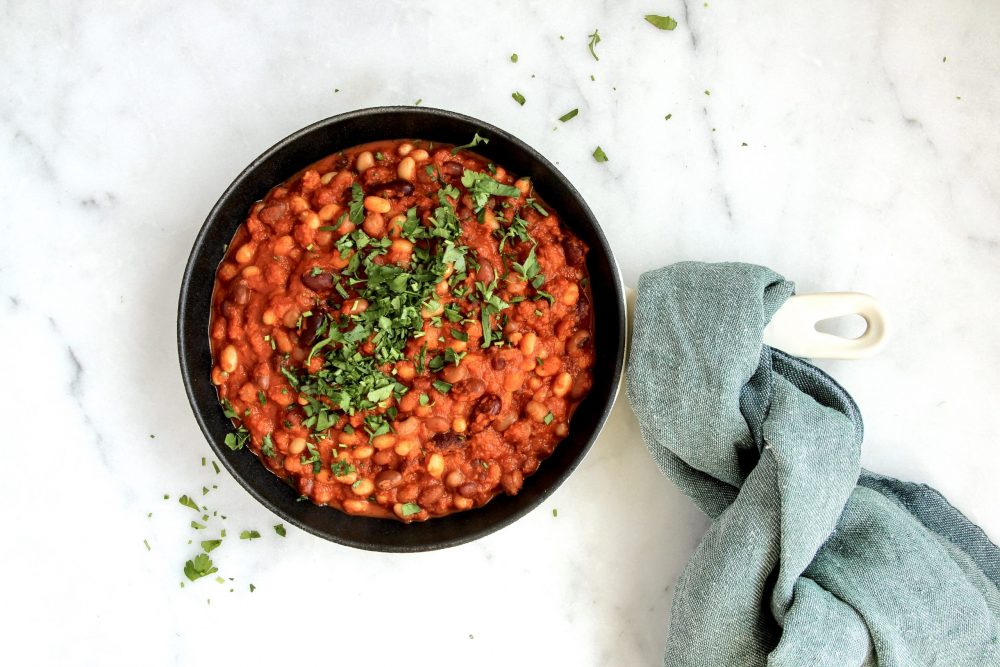
Making your own baked beans can be so satisfying and give you greater control over what goes into them. A quick investigation into baked beans sold in UK supermarkets shows that the average 200g portion of standard baked beans will contain 1g of salt (ranging up to a staggering 1.6g).
It’s Salt Awareness Week (8th-14th March 2021), which aims to highlight the reduction of salt intakes. The UK recommendation is a maximum of 6g salt per day. However, the National Diet & Nutrition Survey showed that the average person was eating 8.4g salt in 2018-2019.
The greatest contributors to salt in our diet comes from processed foods and includes bread, cheese, and meat products such as bacon. Around 8% of our salt intakes comes from pre-prepared vegetables such as frozen chips, mashed potatoes and tinned produce. Watch out for tinned beans, pulses and vegetable is water with added salt. Additionally, watch out for tinned tomato products which add salt in. While salt is a preservative, it is not really needed in these products.
If you are looking to reduce your salt intake, you might find things taste a little bland at first. After a few weeks your tastebuds will become more sensitive to salt. You can always add other flavours to food to help in this transition period; try adding herbs, spices, lemon/lime juice or pepper to your meal.
These homemade baked beans contain a fraction of the salt content of their tinned counterparts, containing just 0.14g per 200g serving. Not only that, but you’ll also benefit from 8.7g of fibre and 11 different plant foods for fibre diversity. In addition, my baked beans are naturally sweetened using a carrot and smoked paprika, meaning there’s no added sugar to these beans either.
Store any leftover beans in an airtight container in the fridge for 3-4 days, or alternatively freeze in handy portions ready for a quick and easy meal.
Makes 7 portions
Ingredients
2 large garlic cloves, roughly chopped
1 large carrot (100g), grated
1 tbsp extra virgin olive oil
500g passata
2 tsp smoked paprika
1/2 tsp ground white pepper
1/4 tsp mixed herbs
1/2 tsp white wine vinegar
2 tbsp tomato puree
1 tin of haricot beans in water
2 tins of mixed pulses in water
Method
Add the garlic, carrots and oil to a large pan and cook over a gentile heat for 5 minutes till softened.
Add the passata, herbs and spices, vinegar, tomato puree and 100ml water. Cook for a further 15-20 minutes over a low heat till the carrots become soft.
Blend to a smooth sauce and add the beans.
Cook over a low heat with the lid on for 15 minutes, stirring occasionally.
Per 200g serving 163kcal/ 3.4g fat/ 0.6g saturated fat/ 19.9g carbohydrates/ 8.7g fibre/ 9.5g protein/ 0.14g salt
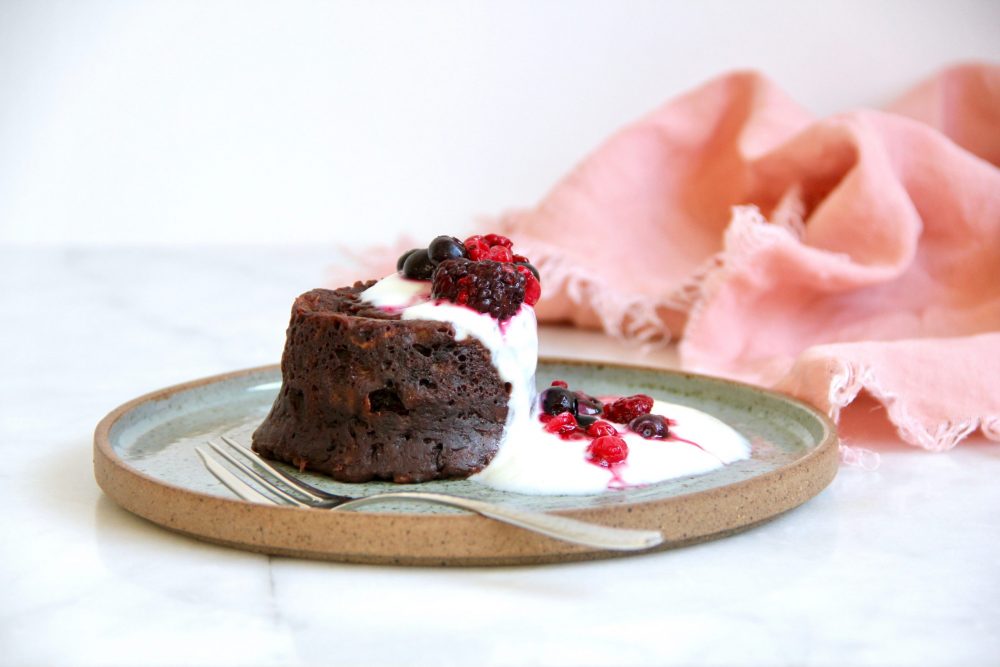
The easiest (and quickest) way to use up some brown Fairtrade bananas from the bottom of your fruit bowl. These little cakes make the perfect pudding in a hurry. There’s also no added sugar thanks to the natural sweetness of the extra ripe bananas, and the addition of a date.
Each cake provides you with 4 different plant points for your weekly tally. If you can resist eating it straight out of the ramekin (be careful as it’s super hot!!) you can turn it out onto a plate and serve it with your choice of toppings. It’s the perfect brunch served with plain yoghurt and berries, but you could always opt for something more indulgent such as custard or ice cream if eating it for dessert.
Sourcing both Fairtrade bananas and cocoa means that those working in the food chain will get a fair wage; from the farmers who grow the produce, to those who process it into the final product so they can have a better standard of living. Fairtrade Fortnight 2021 runs from 22nd February to 7th March. Look out for the Fairtrade logo on popular items such as bananas, chocolate, coffee, tea, flowers and clothing.
Serves 2
Ingredients
60g butter
2 very ripe Fairtrade bananas (total weight 175-200g)
1 egg
1 Medjool date, finely chopped or 20g chopped dates
60g self-raising flour
15g Fairtrade cocoa powder
To serve (optional)
Yoghurt
Defrosted frozen berries
Method
Melt the butter in the microwave for 30 seconds till very soft. Add the bananas and mash into a lumpy paste.
Mix in the egg and chopped date.
Add the flour and cocoa powder and mix till just combined.
Pour into 2 large ramekins. Cook each cake for 90-100 seconds in the microwave (900 W) till puffed up and cooked. If you still have raw batter keep microwaving 10 seconds at a time till cooked.
Leave to cool for 30 seconds before turning out onto a plate and serving with yoghurt and berries.
Per serving: 499kcal/ 29.1g fat/ 18.0g saturated fat/ 31.9g carbohydrates/ 6.3g fibre/ 9.2g protein
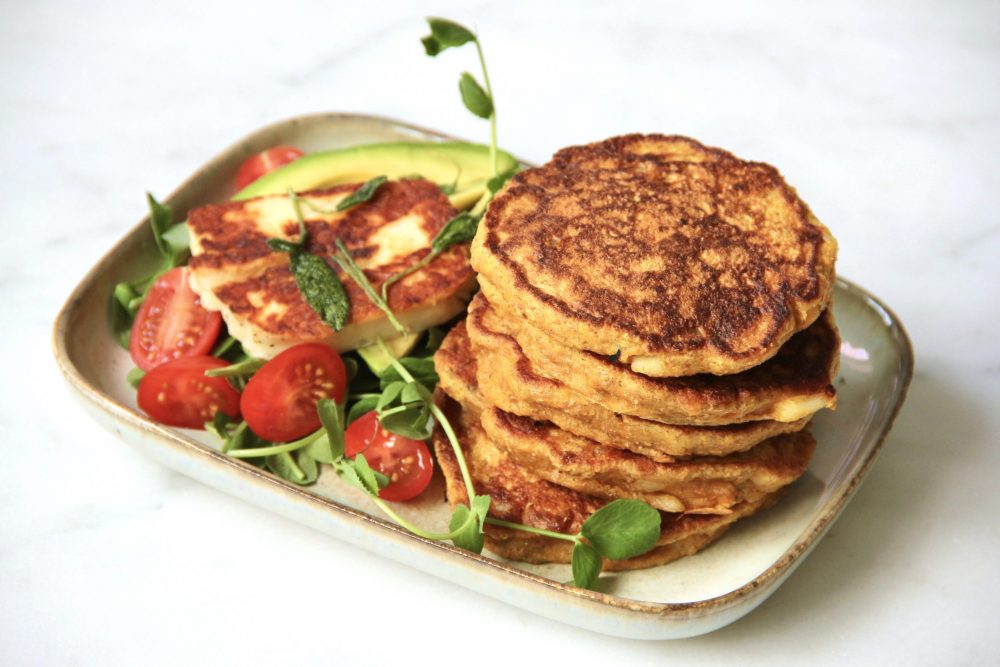
I love the combination of sage and squash. It’s one of my favourite winter flavour duo! Delicious any time of the day; serve at brunch with an egg cooked to your liking, or serve as lunch, or even dinner as a starter or main dish. These would be delicious with a soured cream sauce on the side, or make a spicy tomato and avocado salsa.
Serves 4 as a lighter meal or starter, or 2 as a main
Ingredients
350g squash in large chunks, skin left on
1 large egg
10 sage leaves, finely diced
250ml milk
1 block of halloumi, cut into four 1cm thick slices and the remaining finely shredded
150g wholemeal flour
1 tsp baking powder
1/4 nutmeg, grated
Olive oil for frying
Method
Roast the squash in a pre-heated oven set at 180°C for up 45 minutes till soft. Allow to cool slightly before peeling off the skin. You should have approximately 180-200g cooked squash.
Mash the squash in a large bowl, before adding in the sage, egg, milk and diced halloumi.
In a separate bowl, mix the remaining dry ingredients before combining with the wet ingredients. Mix to form a batter the consistency of thick double cream.
Heat a frying pan over a medium heat and add 1/2 tsp olive oil.
Allowing space between each pancake, take a ladel of batter and make a round for each pancake, allowing the mixture to spread naturally. Cook in batches according to the size of your frying pan.
Cook for 2 minutes per side, flipping with a spatula once bubbles have risen to the surface and the edge starts to dull. Cook for a further 2 minutes on the second side.
Keep cooked pancakes warm in an oven set to 100°C on a tray, keeping pancakes to a single layer if possible.
Once all the pancakes are cooked, add the remaining slices of halloumi to the pan and fry till crispy and golden on both sides.
Serve the pancakes in stacks and top with crispy halloumi.
Per serving: 406kcal/ 21.4g fat/ 11.3g saturated fat/ 33.4g carbohydrates/ 5.9g fibre/ 19.0g protein
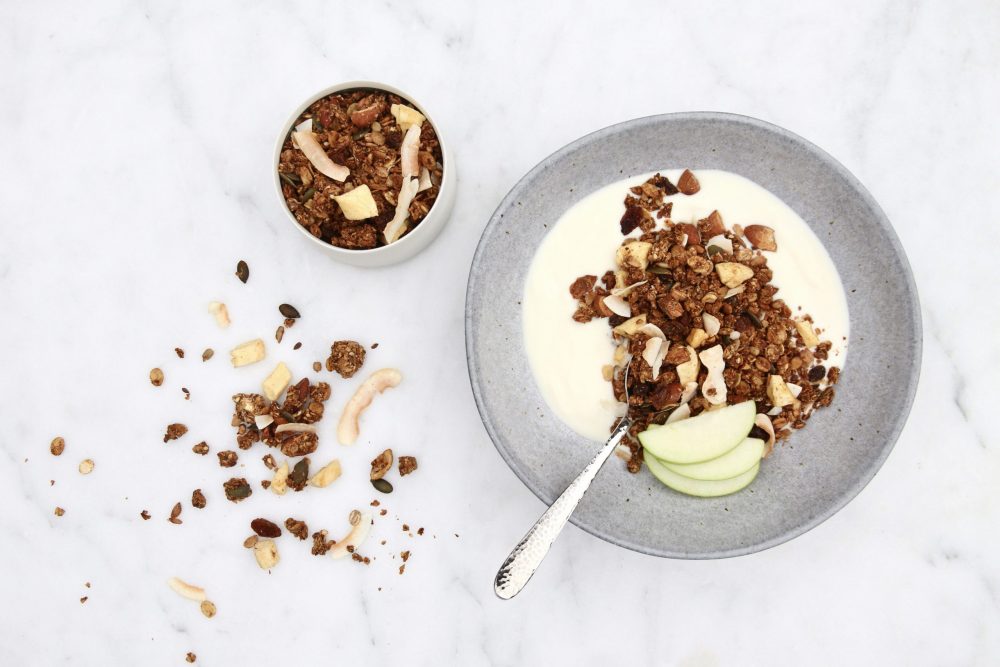
A winter version of my no added sugar granola is sure to please in the cold weather; warming cinnamon is paired with sweet apples making for the perfect pick-me-up for dark mornings.
Cinnamon is a spice containing lots of polyphenols, a type of plant chemical which is thought to be beneficial to health. In total, this granola is packed full of 16 different plant foods, providing you with just over half of your weekly diversity goal in just the granola on its own.
If you don’t have all the specific ingredients, try swapping them to maintain fibre diversity. You could use alternative grains to those listed, or use different nuts which can change the healthy fat profile of this granola.
Makes 16 servings
Ingredients
100g stoned dates
150g oats
50g barley flakes
50g rye flakes
50g spelt flakes
15g ground sweet cinnamon
75 mixed seeds (I have used 15g each of chia, linseed, sesame, sunflower and pumpkin seeds)
80g almonds, roughly chopped
50g unsweetened desiccated coconut
50g extra virgin olive oil
30g coconut flakes
70g dried unsweetened apple
70g sultanas
Method
Preheat the oven to 120°C fan/ 130°C convection
Soak the dates in 150ml boiling water for a few minutes before blending into a smooth paste.
Meanwhile, mix the cereal flakes, cinnamon, seeds, almonds and coconut together.
Add the date puree and mix everything together.
Pour the oil in, mix, and then spread out onto a tray.
Bake for 90 minutes, stirring at minutes 30, 50 and 70.
Add the coconut flakes in for the last 20 minutes, before removing and allowing to cool.
Mix in the dried fruit and store in an airtight container.
Per 50g serving: 196kcal/ 6.4g fat/ 3.3g saturated fat/ 22.3g carbohydrates/ 5.8g fibre/ 5.4g protein
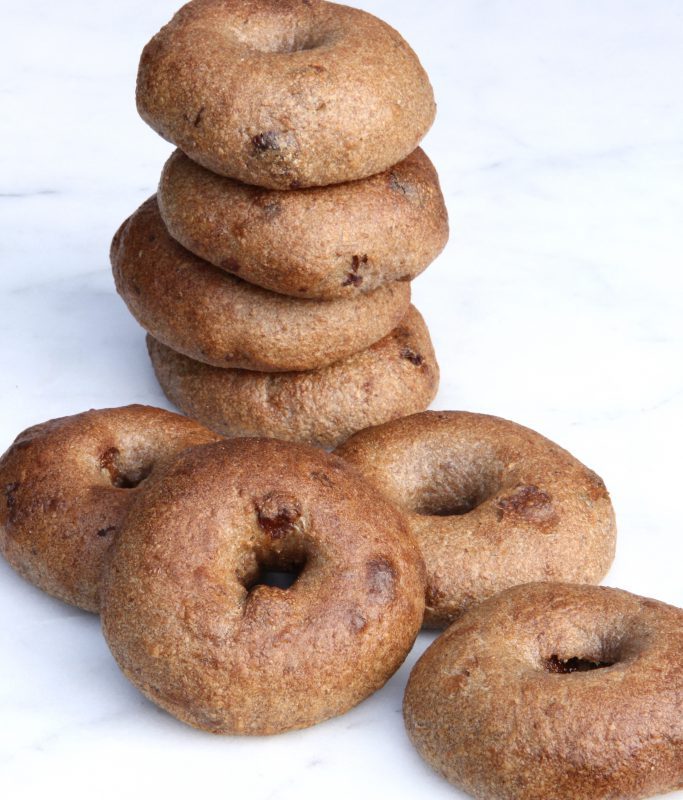
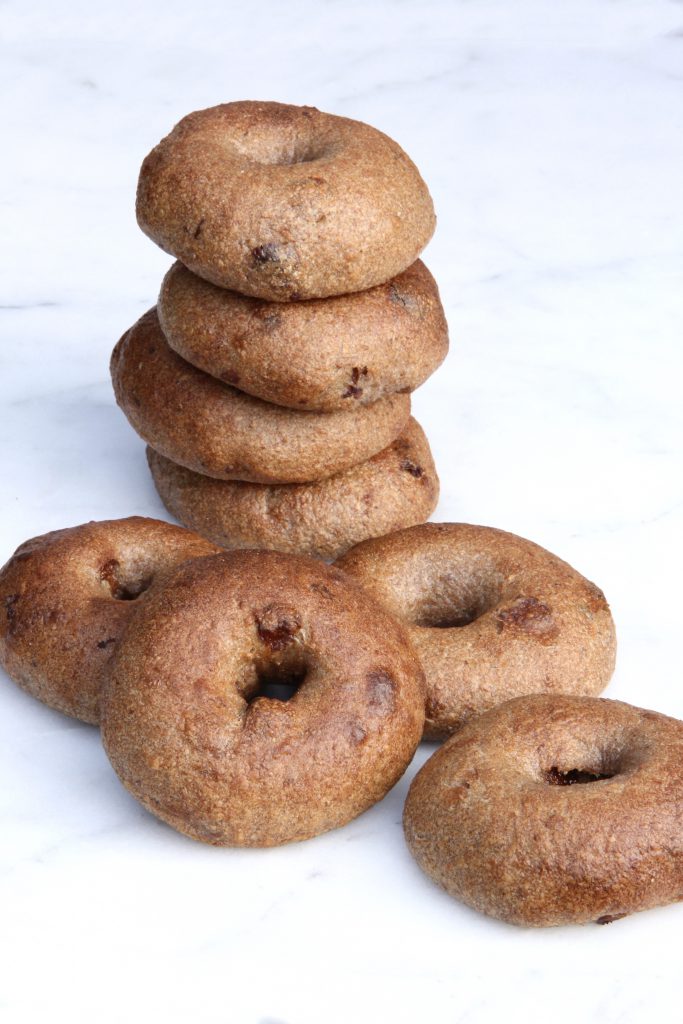
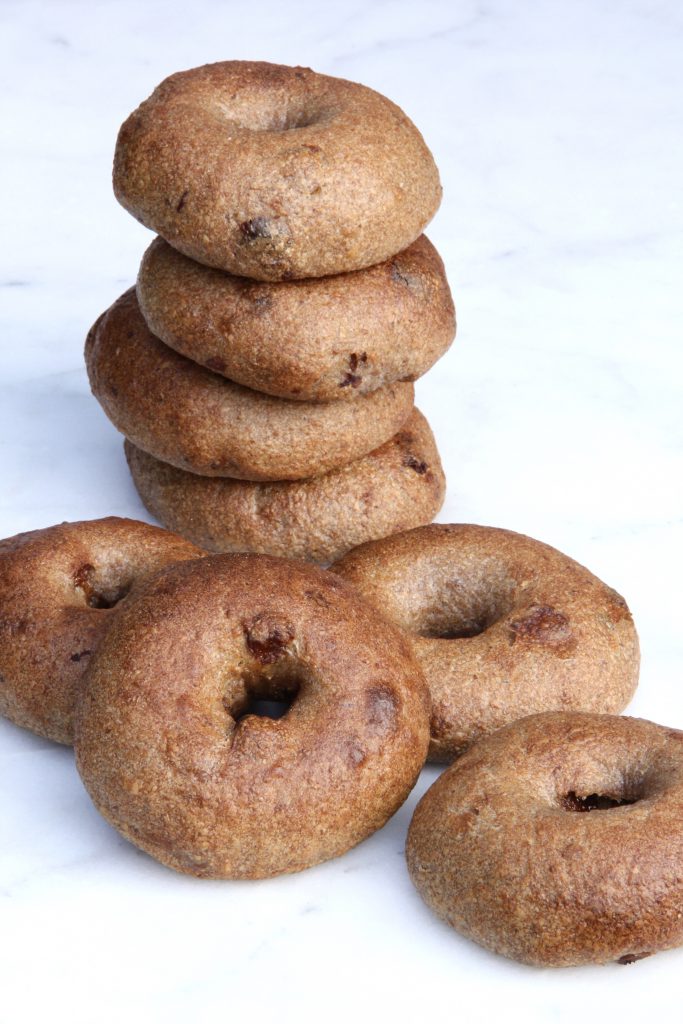
When I presented seeded multigrain sourdough bagels to my brother, the first thing he said was that I needed to make cinnamon and raisin sultanas. So grateful(!) but I took the constructive criticism and made this recipe for him.
I’ve adapted the Margot Bakery sourdough bagel recipe. It’s a great recipe, however, I could never fit 12 bagels onto my baking sheets, and the volume of dough was too large for my stand mixer! I also wanted to incorporate more wholemeal flour as a way of increasing the fibre content. I also didn’t have the malt syrup, so for anyone who wishes to make vegan bagels, swap the honey back out for the original malt syrup.
You could of course do the more traditional approach of cinnamon and raisin bagels, but I have always preferred sultanas over raisins. Other fruits that would work well in this recipes include dried blueberries, cranberries or cherries.
The bagels are best eaten fresh on the day, although still delicious if left for a day or two. A great way to capture that freshness is to slice the bagels in half and then freeze. This way they are ready to pop straight into the toaster from the freezer and are ready to be eaten within minutes.
Makes 12 bagels
Ingredients
For the leven
35g 50:50 strong white: strong wholemeal flour
115g 50:50 strong white: strong wholemeal flour
25g granulated sugar
For the dough
20g honey or malt syrup if making vegan
180g strong white flour
180g strong wholemeal flour
400g plain flour
12g salt
10g ground sweet cinnamon
120g sultanas
Extras
Vegetable oil
50:50 mix plain flour: rice flour
2 tsp bicarbonate of soda
Sourdough Cinnamon and Sultana Bagels
Method
The morning before making the bagels, refresh your starter with 35g 50:50 strong white: strong wholemeal flour and 35g water. Mix and leave for 10-12 hours.
The night before making the bagels, in a large jar mix 70g of the refreshed starter mixture, 115g 50:50 strong white: strong wholemeal flour, the sugar and 70g water. Leave for 10-12 hours.
The next day, mix all the remaining ingredients, 425g water and 250g of the refreshed starter. Knead the dough on a medium setting of a stand mixer fitted with a dough hook, frequently scraping down the sides and hook, for around 8-10 minutes. Alternatively, you can work the dough by hand, but it will be sticky so resist the urge to add extra flour. Knead for 10 minutes.
Lightly grease a 3l container. Transfer the dough, cover and allow to rest at room temperature for 3 hours.
Line 2 large baking trays with baking parchment and dust with 50:50 rice and plain flour.
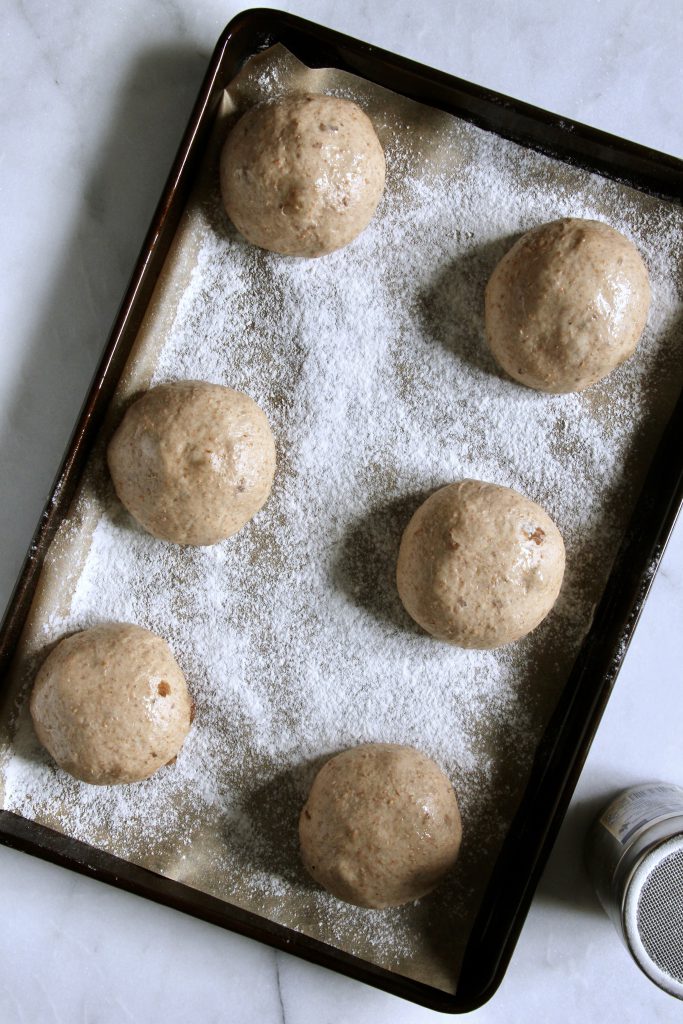
Divide the dough into 12 equal portions and roll out into neat balls. Try to tuck any sultanas into the dough to prevent burning when baking.
Place 6 balls evenly spaced out onto a tray and cover with lightly oiled clingfilm. Leave to rest for 1 hour at room temperature.
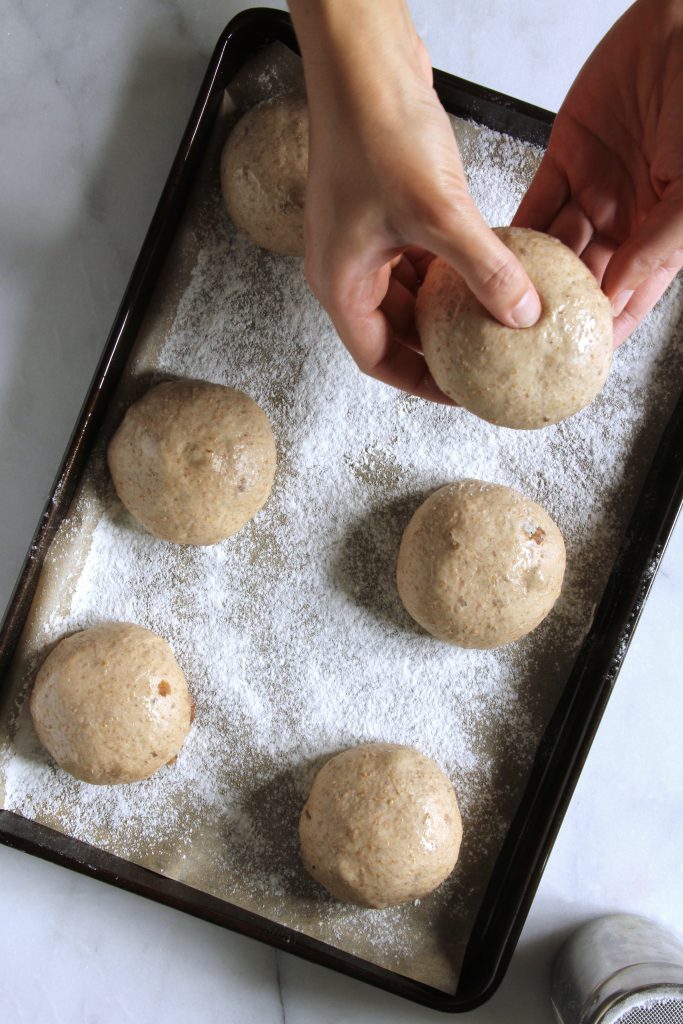
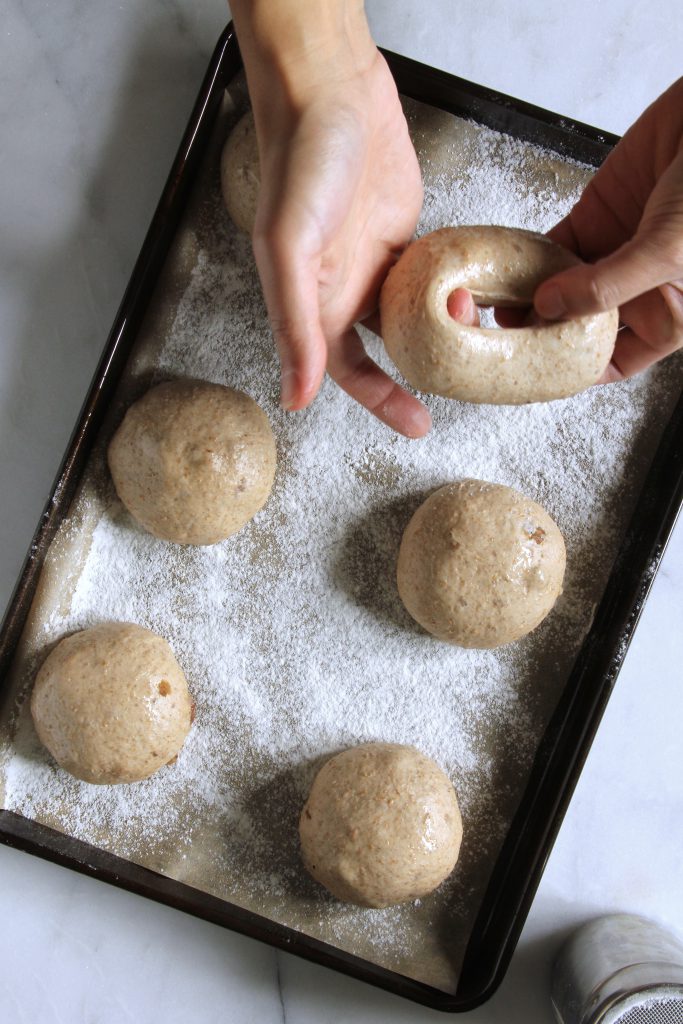
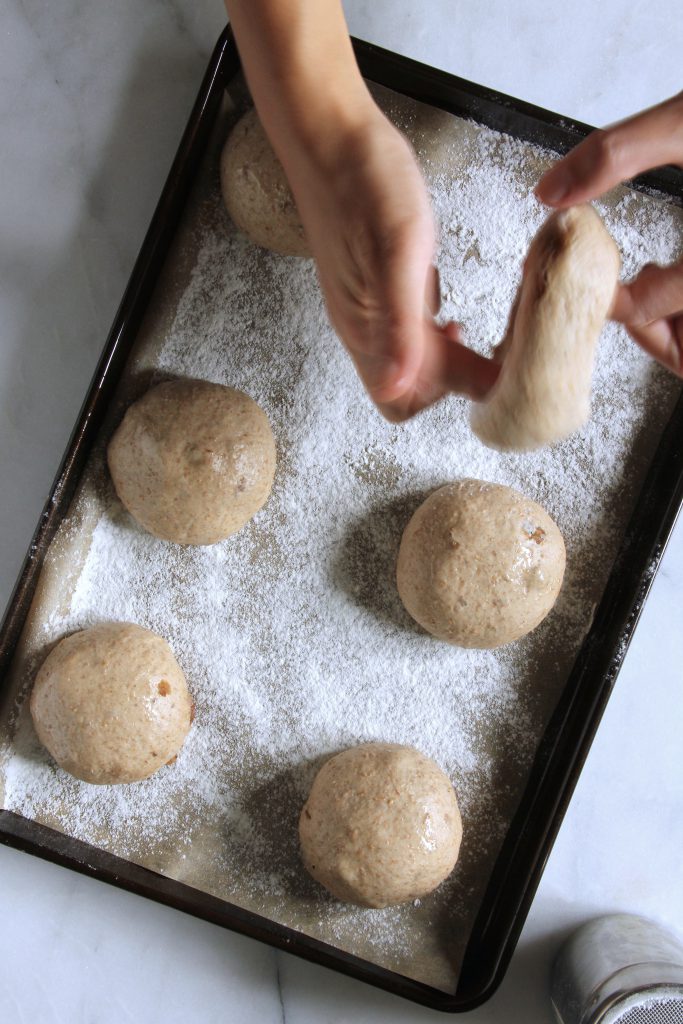
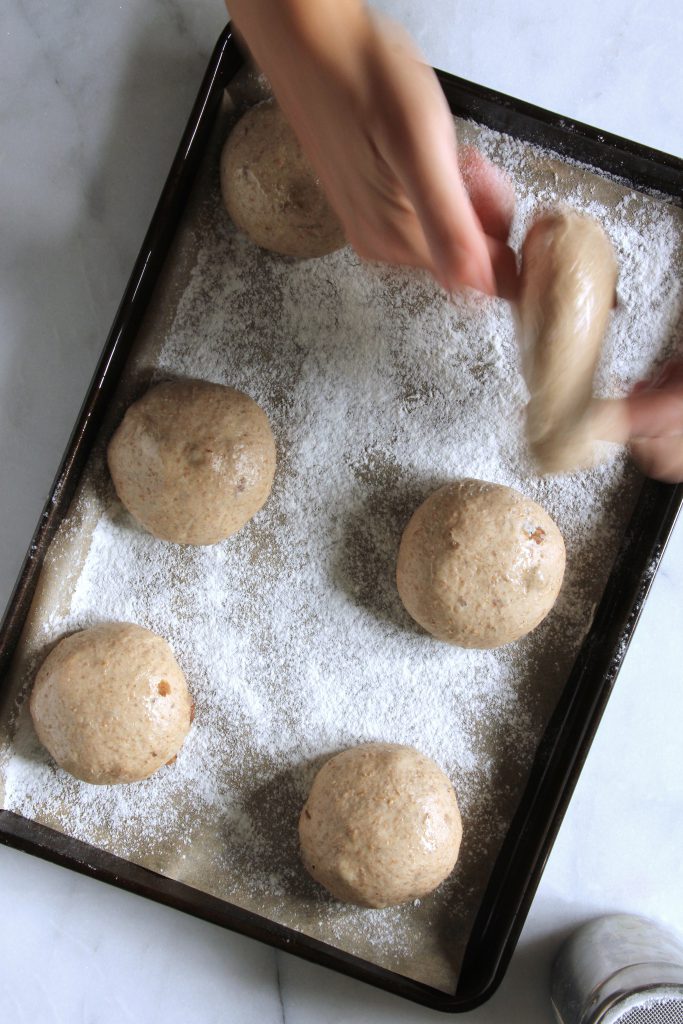
Peel back the clingfilm, take one ball and make a hole in the centre of the ball. Using two fingers, stretch the ball into a bagel shape using a winding motion. Redust the parchment with 50:50 rice and plain flour and place the bagel back down.
Repeat for the remaining 5 balls on the baking tray.
Starting back with the first bagel, repeat the winding stretch to open the bagel back up.
Cover back up with the oiled cling film and leave to prove at room temperature for 3-6 hours depending on the temperature of the room; in warmer weather prove for a shorter period of time.
Transfer to the fridge overnight for up to 24 hours.
The next day remove the bagels from the oven and allow to return to room temperature.
Preheat the oven to 220°C fan/240°C convection, place a tray in the bottom of the oven, and bring 2l of water to the boil in a large pan.
Once the water is boiling add the bicarbonate of soda.
Boil the bagels in batches of up to 3 depending on the size of your pan for 30 seconds.
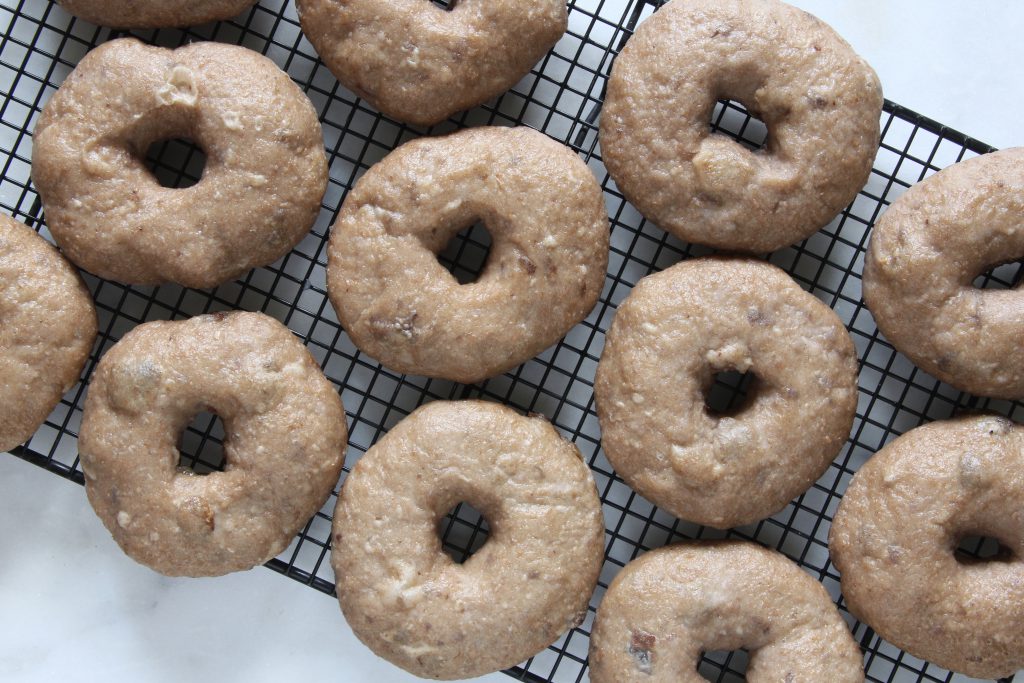
Remove and allow to dry slightly on a wire rack before transferring to a clean baking sheet lined with baking parchment, allowing space for them to expand in the oven.
Boiled bagels ready for baking
Once all the bagels are boiled, boil 200ml water.
As quickly as possible, place the trays of bagels into the oven and pour the boiled water into the tray at the bottom of the oven.
Close the door to trap as much steam as possible. Reduce the temperature of the oven to 20°C and bake for 15 minutes.
After 15 minutes, remove the tray of water and if your bagels are on split levels, rotate your trays around for even cooking. Bake for a further 8-9 minutes.
Remove and allow to cool on a wire rack.
Per bagel: 205kcal/ 1.2g fat/ 0.2g saturated fat/ 41.2g carbohydrates/ 3.1g fibre/ 6.6g protein
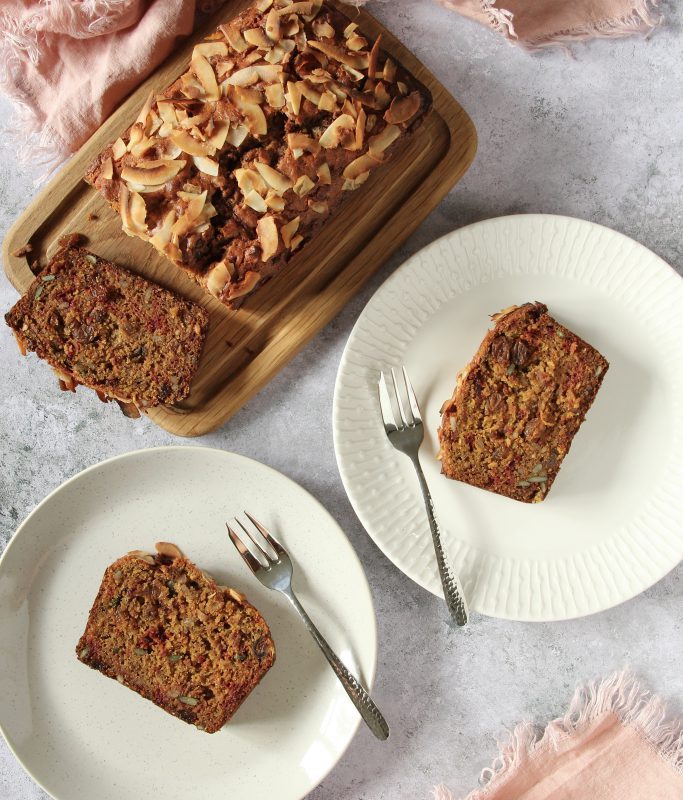
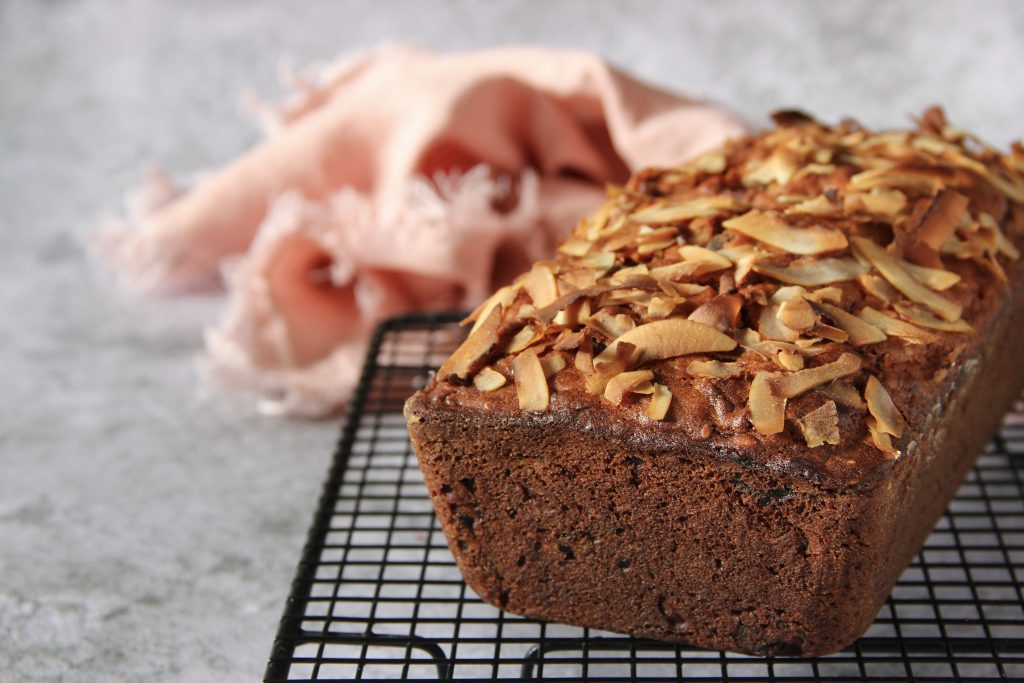
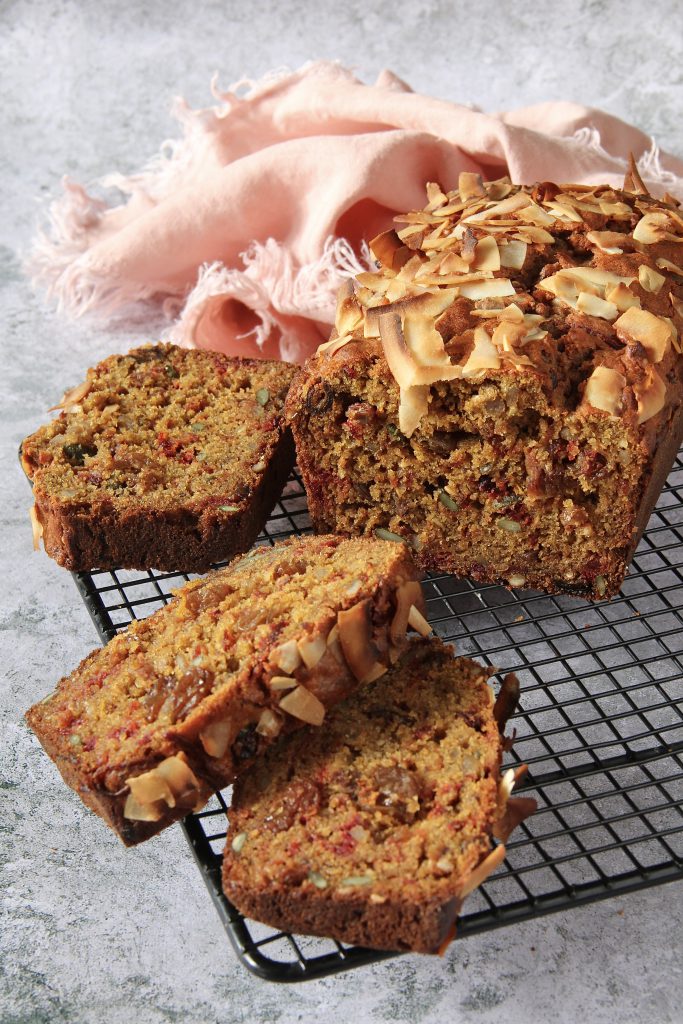
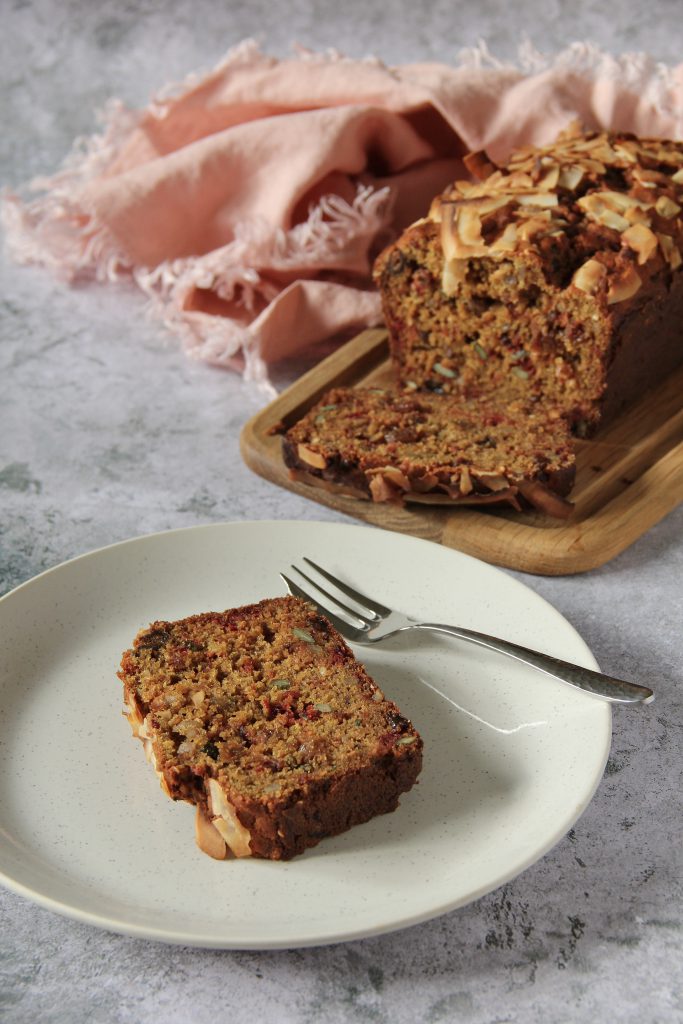
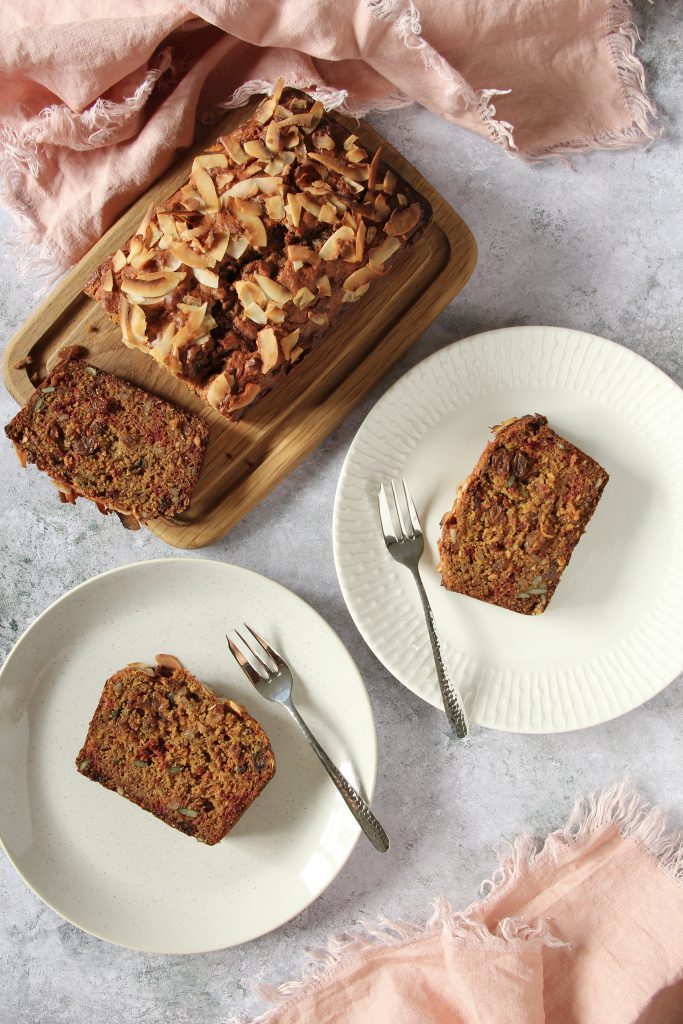
This recipe was inspired by a recipe by Nigel Slater which I started making after growing beetroots for the first time (and rather successfully I might add). We had so many beetroots to use up I had to try to find new recipes to use them in. I thought this recipe was so delicious and was an easy way to use the rapidly growing beetroots.
I decided to make my own version of this cake seeing as there is so much added free sugars in the original recipe. While sugar is sugar at the end of the day, swapping dates in the place of sugar doesn’t make this cake much healthier than the original, but it is a nice twist which adds a little extra fibre diversity into the mix.
It’s also worth point out that while this recipe was going through the developmental stages I learnt that you cannot blend the dates directly with the oil as you would with water. It makes the most sticky mess and I almost gave up! So trust me on this one, blend with the water first and the mix in the oil at the end. That way there won’t be any frustrated cake tears.
Serves 10
Ingredients
Butter or oil, for greasing
125g dates
2 eggs, separated
Zest and juice of half a lemon
180g self-raising flour
1/2 tsp bicarbonate of soda
1 tsp baking powder
1/2 tsp ground cinnamon
120ml extra virgin olive oil
170g/5oz raw beetroot, peeled and grated
75g/3oz sultanas or raisins
75g/3oz mixed seeds (such as sunflower, pumpkin and linseed)
10g coconut flakes
Method
Preheat the oven to 180°C fan/200°C convection.
Line a 1lb bread tin with baking parchment and grease the sides lightly.
In a jug, blend the dates and 50ml boiling water to a thick paste consistency. Add the egg yolks and lemon juice and mix before adding the oil and grated beetroot.
In a separate bowl, sieve the flour, bicarbonate of soda, baking powder and cinnamon together. Add the lemon zest, sultanas and seeds, mixing to evenly disperse them.
In a clean bowl, beat the egg whites to a soft peak consistency.
Mix the beetroot mixture with the dry ingredients, mixing to a batter before gently folding the egg whites in.
Pour into the lined tin, top with coconut flakes and bake for 40-45 minutes, covering with foil after 20 minutes. The cake is cooked when a skewer inserted into the middle of the cake comes out clean.
Leave to cool in the tin for 20 minutes before turning out onto a wire rack to cool completely.
Per slice: 291kcal/ 16.6g fat/ 2.9g saturated fat/ 28.9g carbohydrates/ 2.8g fibre/ 5.8g protein
At present I currently have courgettes coming out of my ears! 1 courgette plant would be sufficient to feed a small family with a steady supply of courgettes each week. So naturally we have 10 plants (not to mention the questionable marrow-looking plants) and I am spending all my free time trying to work out new ways of giving courgettes away to unwilling neighbours – they are all currently sick of courgettes too!
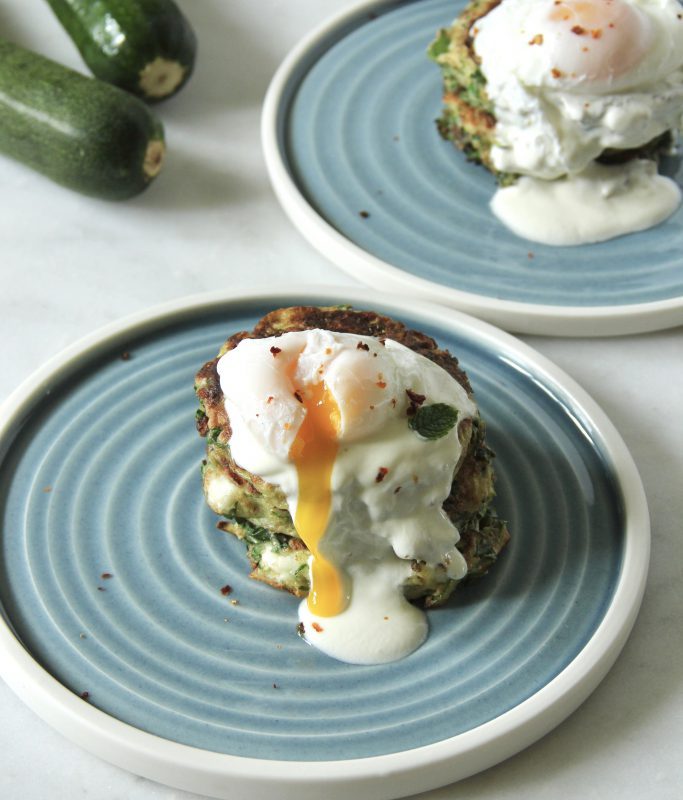
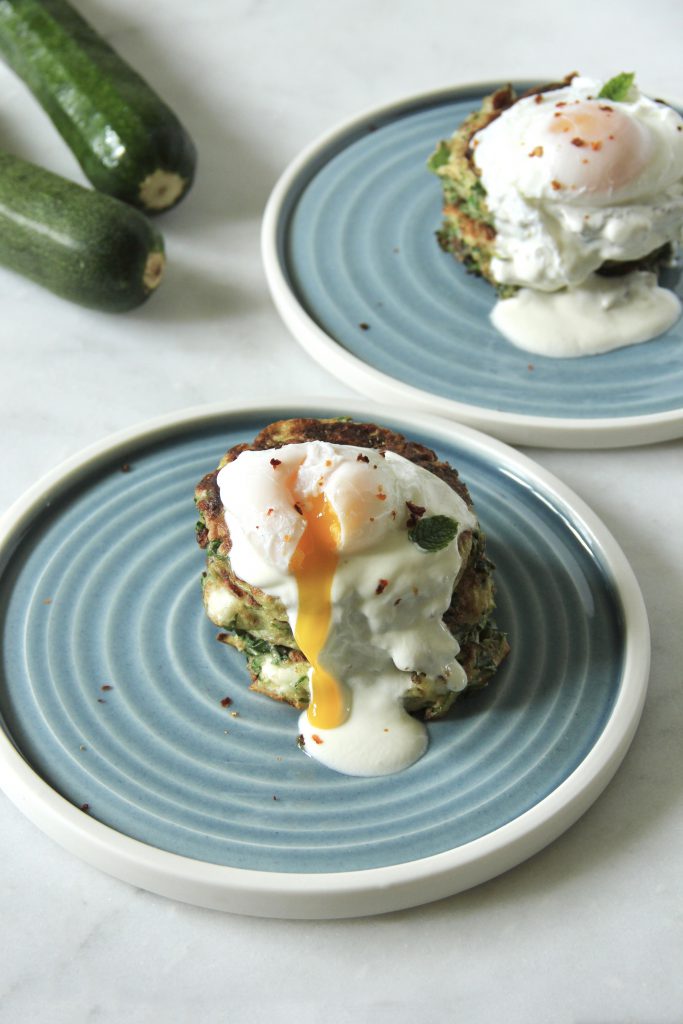
Making these super light fritters is the perfect way of using up a courgette or two. You simply do not realise you are eating courgette till you have wiped the plate clean.
Serves 2
Ingredients
1 medium courgette, around 180g, grated
1 medium egg
50g wholemeal flour
1/2 tsp baking powder
50ml milk
10 mint leaves, finely sliced
1 garlic clove, finely grated
40g flat leaf parsley, roughly chopped
70g feta cheese, crumbled
Chilli flakes to taste
Extra virgin olive oil to fry
Options to serve with:
Sour cream
Poached egg
Avocado
Smoked salmon
Salad
Method
Combine the flour and baking powder together in a large bowl and mix. Season with pepper to taste.
Add the milk and egg to make a batter. Add the remaining ingredients and stir to combine.
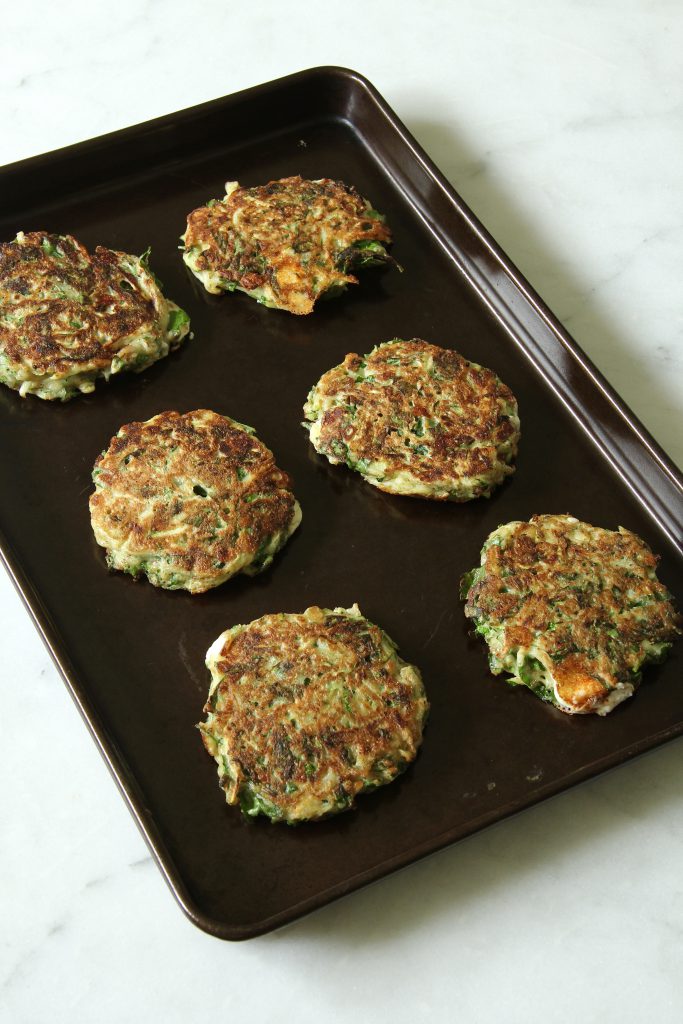
Heat a pan with 1/2 tsp olive oil and add a spoonful of batter into the pan, spreading them out so each round does not touch another. You should be able to make around 6 fritters in total.
Fry each fritter for 2 minutes per side till golden brown. Repeat till all the batter is used. If you are making a larger quantity keep them warm on a tray in a pre-heated oven set to 100°C.
Serve hot with your toppings of choice.
Per 3 fritters: 265kcal/ 12.3g fat/ 7.1g saturated fat/ 23.6g carbohydrates/ 4.3g fibre/ 15.0g protein
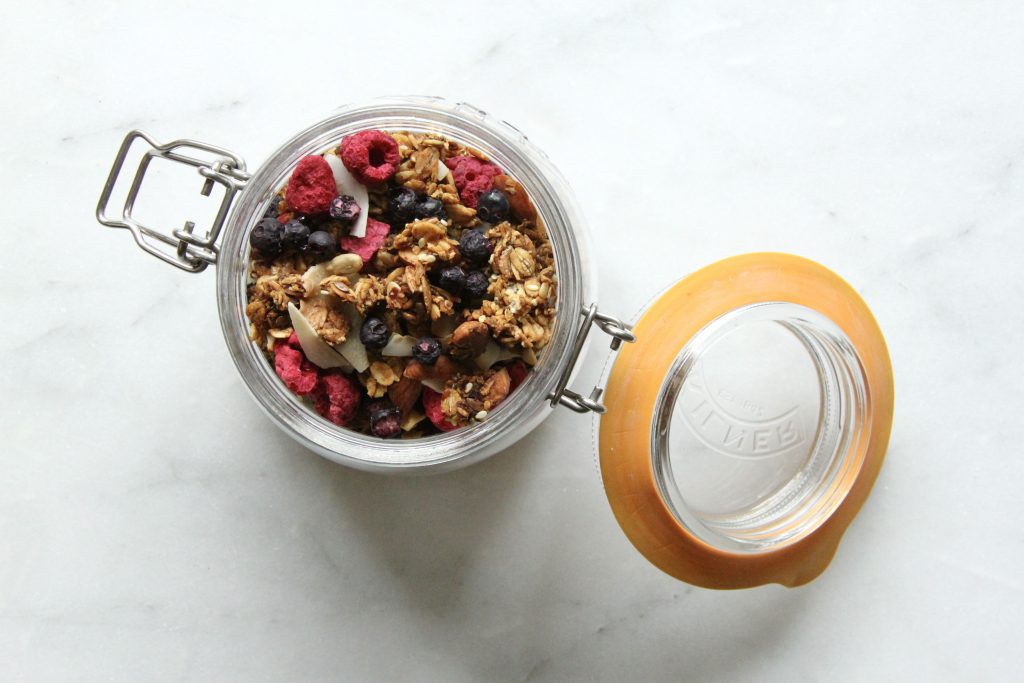
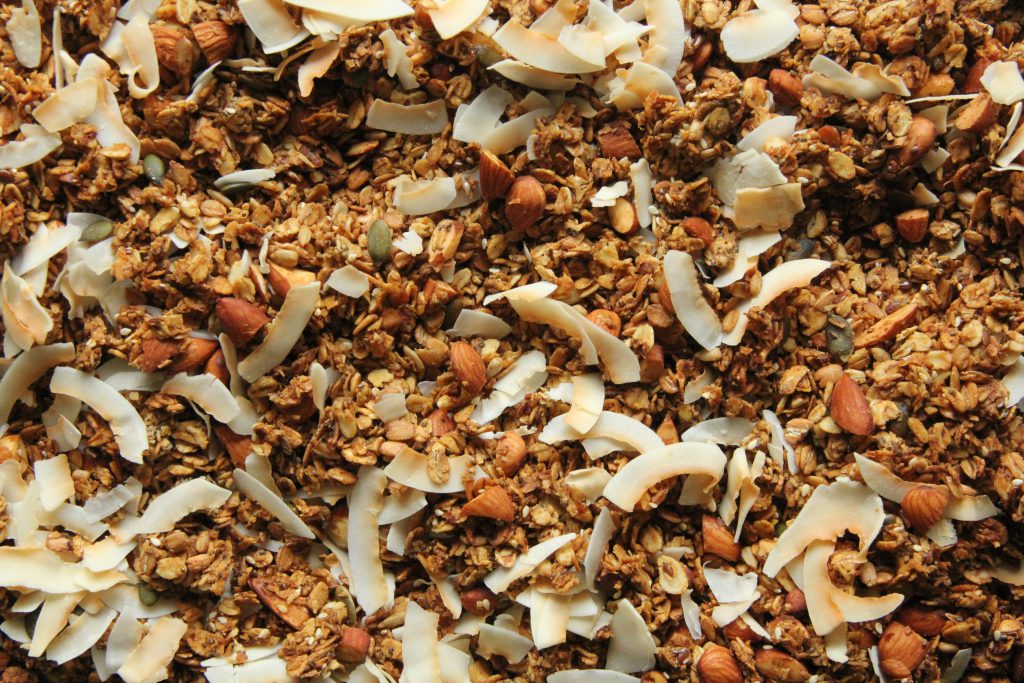
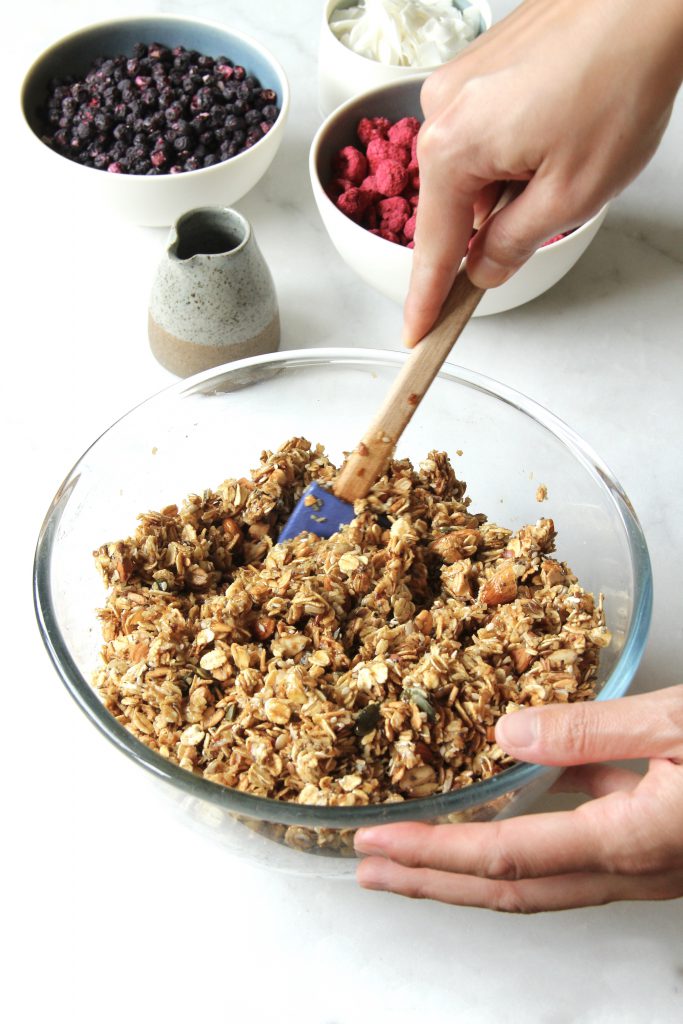
Granola doesn’t last long in my house. Whenever I make a tray, it will be gone within a few days. Seriously. It’s such a delicious way to get a variety of plant-based foods into the diet. In fact, the below recipe contains 15 plant-based foods, that’s half of your weekly recommended target. So this granola is really a winner!
In addition, each portion of granola contains 5.7g fibre. It also had another bonus of no added sugar. Instead, I used dates and blend them with hot water to create a sweet puree which helps the clusters form together. This also means it’s not overly sweet and feels much lighter than other generic granolas.
Using a variety of different cereal flakes also helps increase diversity; these are widely available at your local supermarket or health food shop. I’ve used jumbo oats with some rye, spelt and barley flakes which help increase the fibre content as well as the diversity of my weekly plant food intakes.
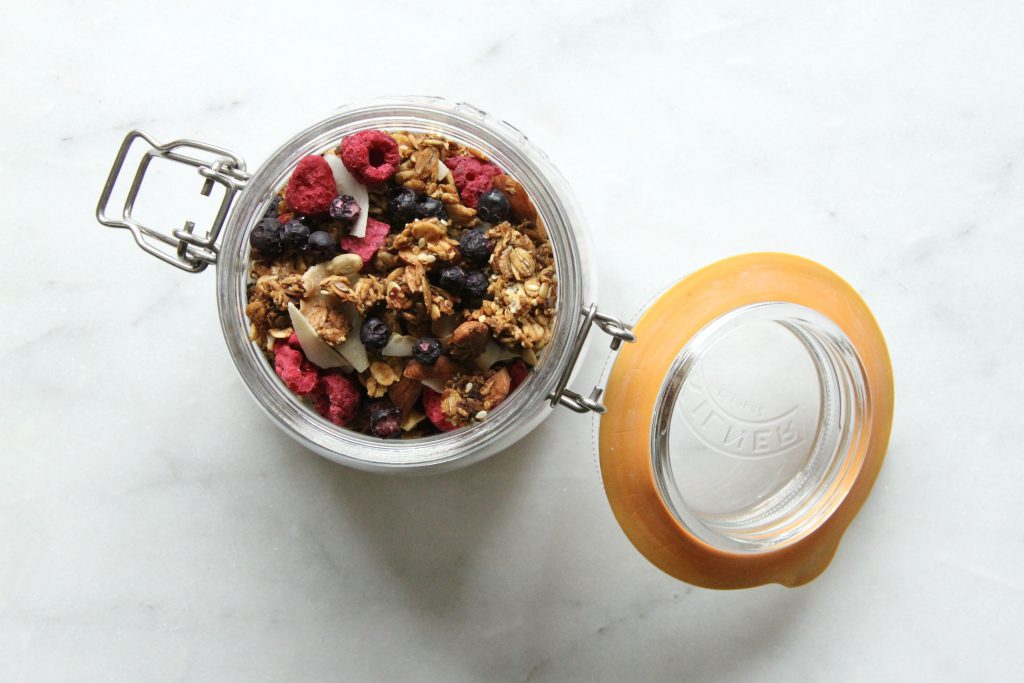
I’ve have used freeze-dried fruits in this granola. This means that they have been dried under cold conditions which are thought to help maximise the retention of heat-sensitive nutrients such as vitamin C, some B vitamins as well as phytochemicals and antioxidants. If you don’t have these to hand you can use other dried fruits such as raisins or apricots, or try adding some dehydrated vegetables for an extra fibre kick.
Makes 15 servings
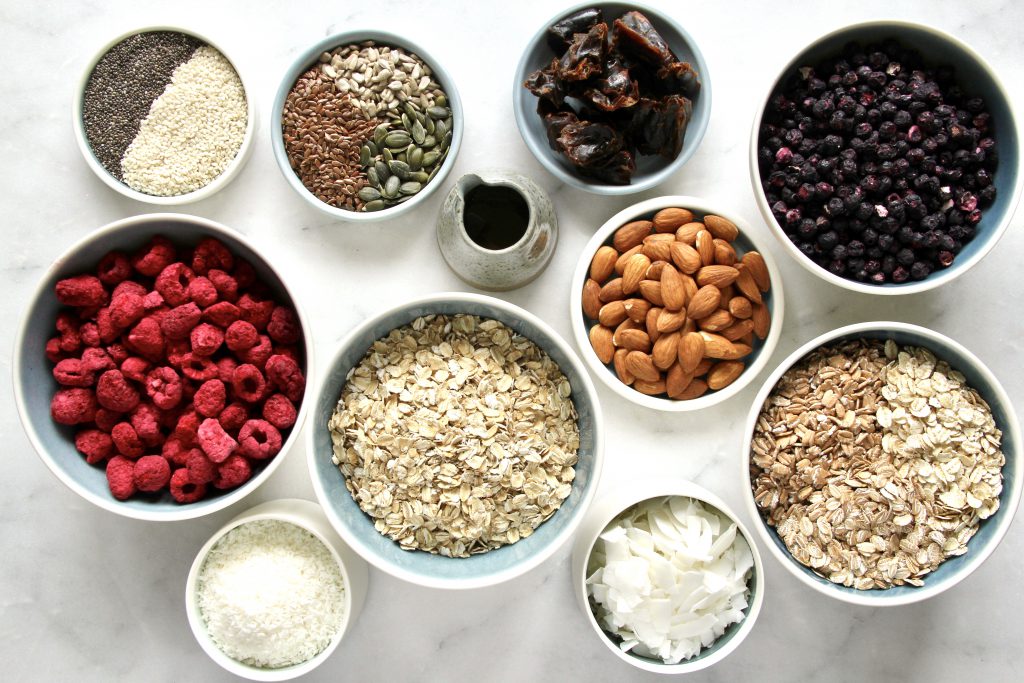
Ingredients
100g pitted dates
150g oats
50g rye flakes
50g barley flakes
50g spelt flakes
50g desiccated coconut
75g mixed seeds (chia, pumpkin, sunflower, sesame, and linseed)
80g almonds, roughly chopped
50ml Extra Virgin Olive Oil (EVOO)
40g coconut chips
35g freeze-dried raspberries
35g freeze-dried blueberries
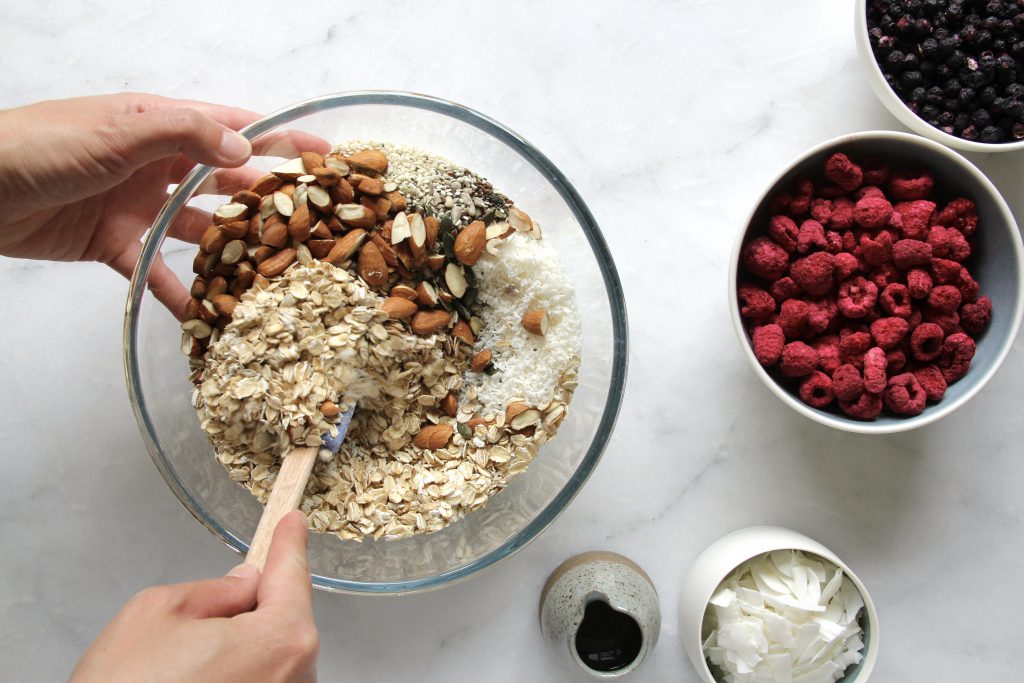
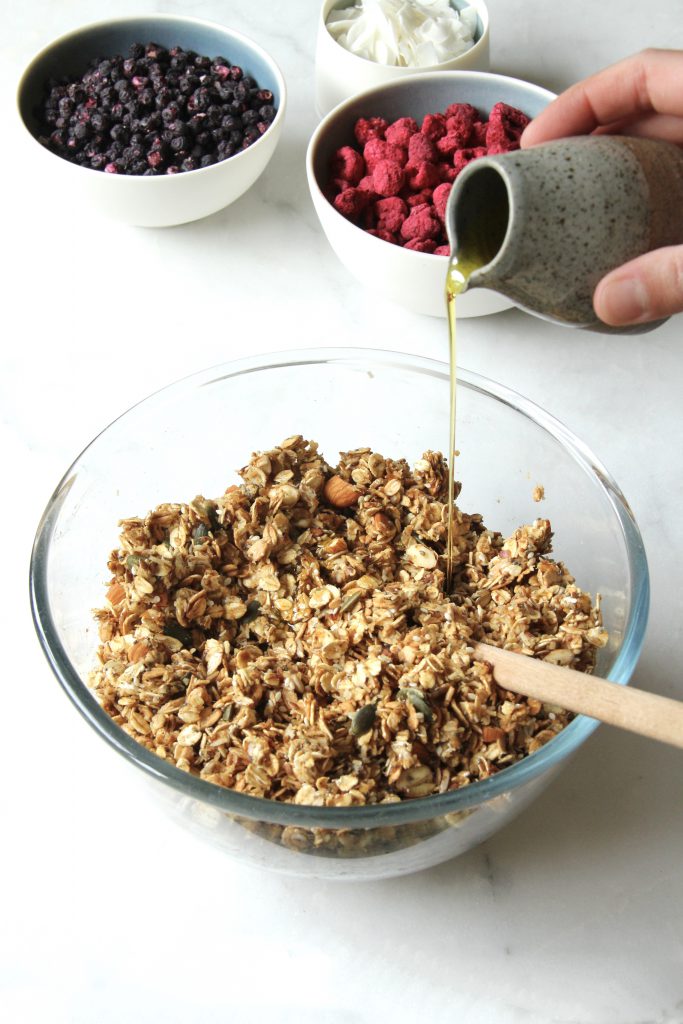
Pour in the EVOO
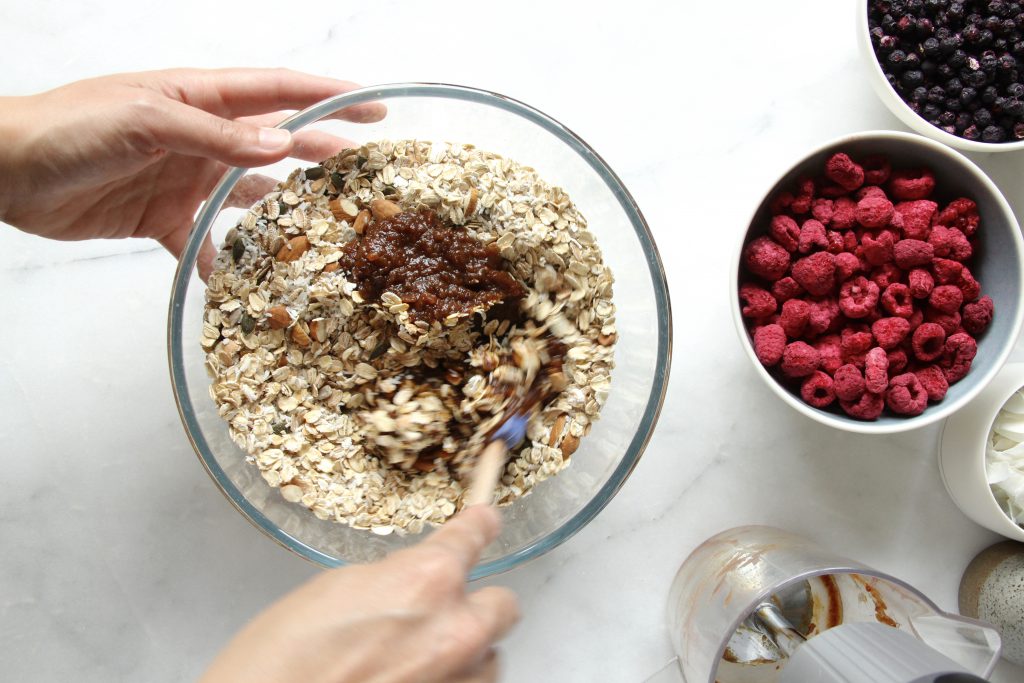
Mix
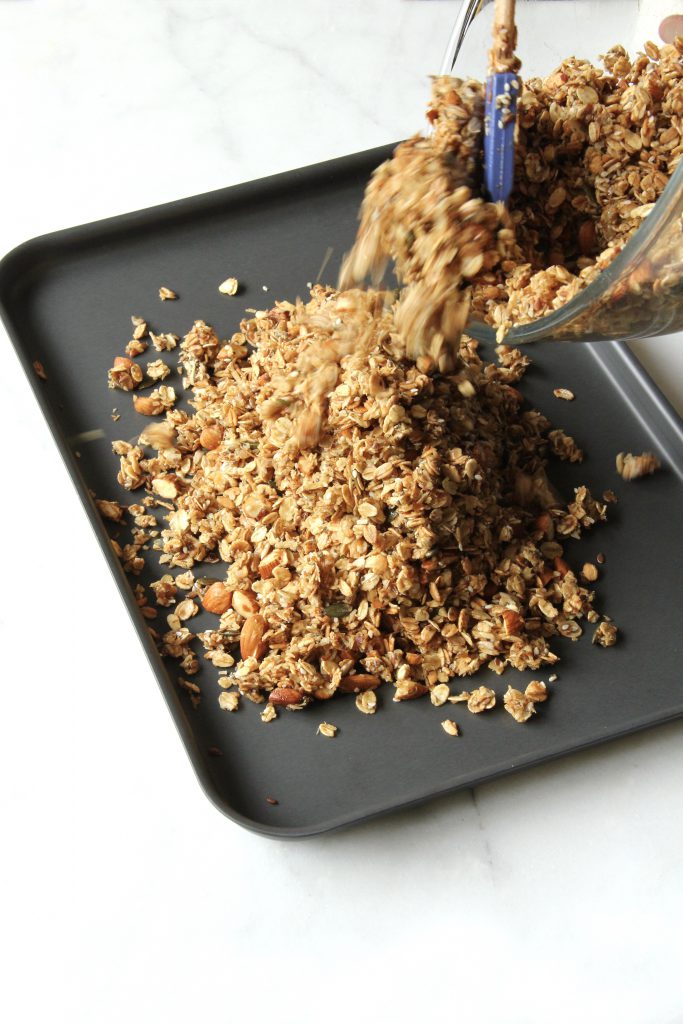
Pour onto a baking tray
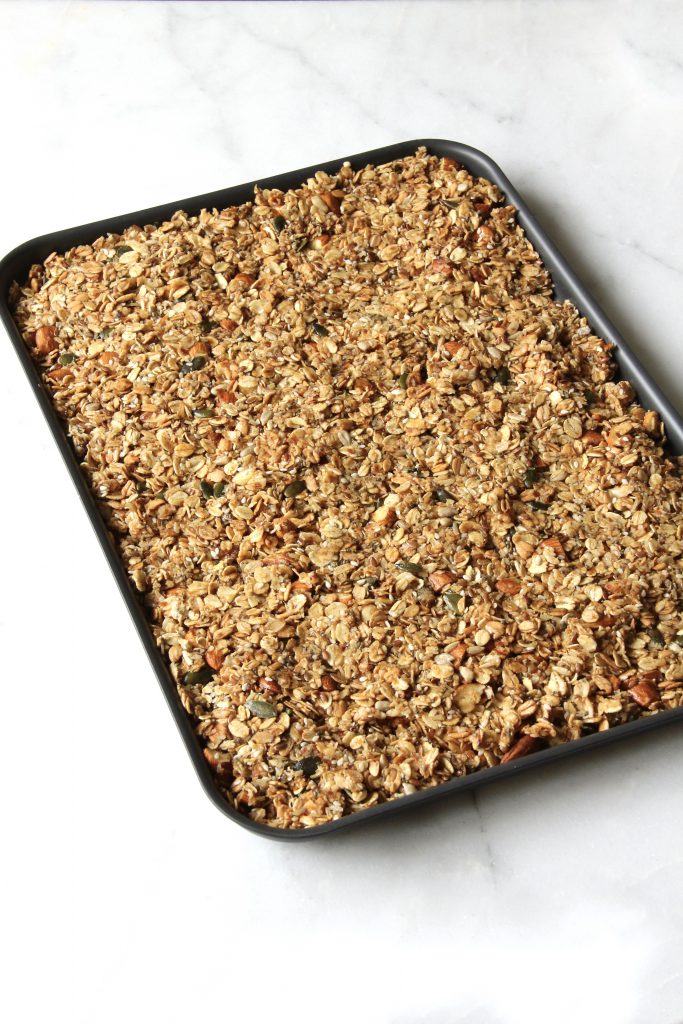
Press down to help for clusters
Method
Preheat the oven to 120°C Fan/130°C convection or Gas Mark 1/2.
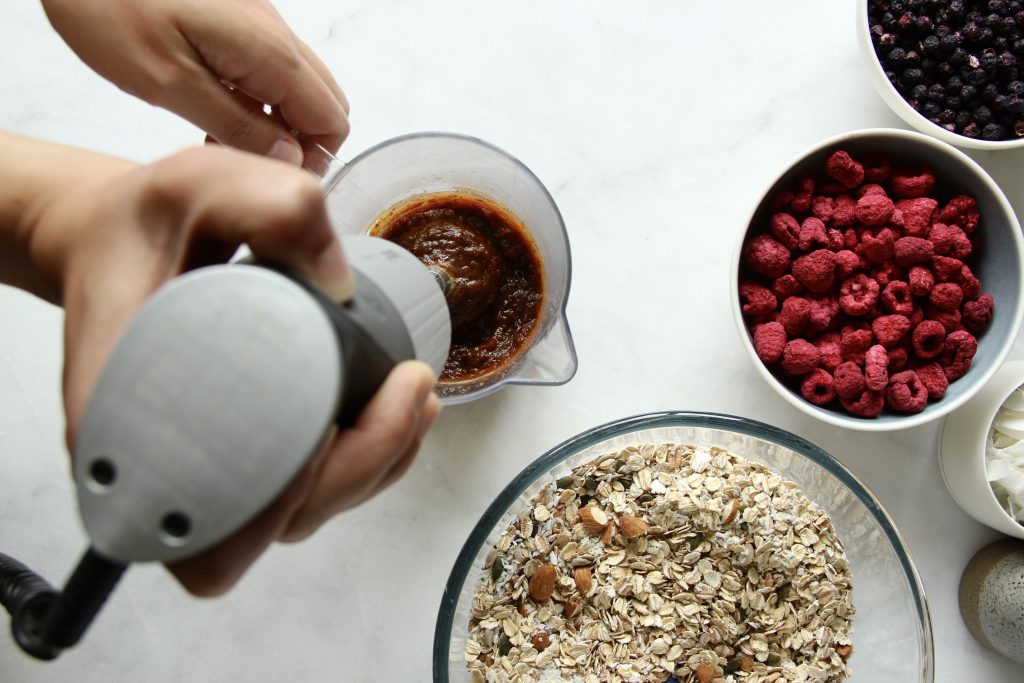
Pour 150ml boiling water onto the dates and allow them to soak.
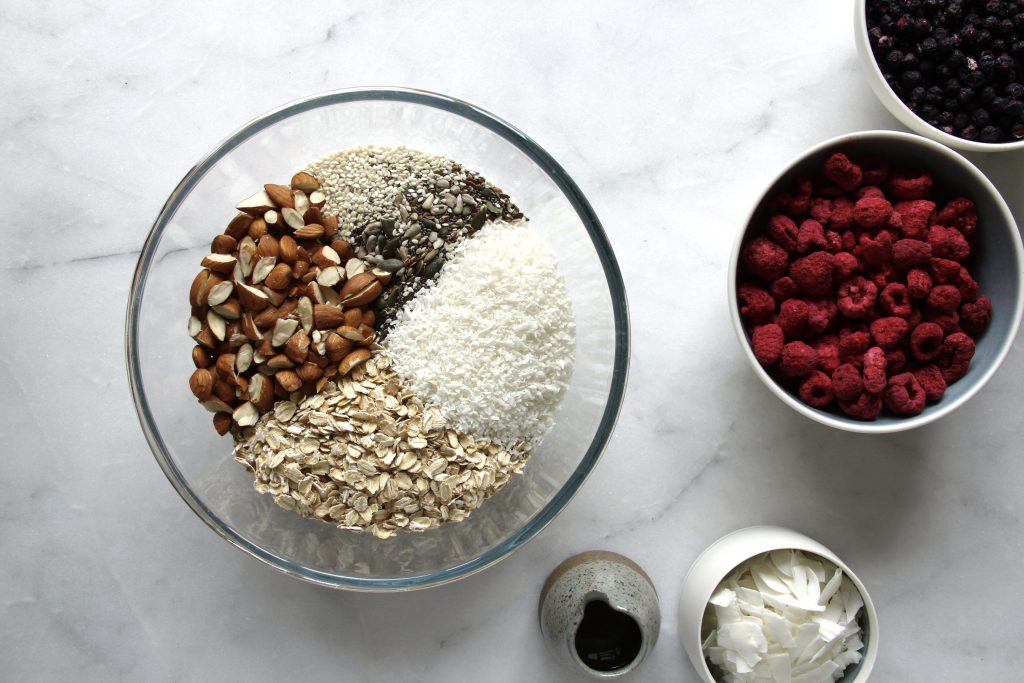
Meanwhile, mix all the oats, flakes, desiccated coconut, seeds, and nuts in a bowl.
Using a hand blender or a food processor, blend the dates in the water to a puree. Empty into the dry ingredients and mix.
Add the EVOO and mix together. Pour onto a large baking tray and, using the back of a spoon, press the granola down to form clumps.
Cook in the oven for 90 minutes in total, gently turning the granola at 30, 50, and 70 minutes.
At 70 minutes add the coconut flakes to the mixture before cooking for the final 20 minutes.
Remove from the oven and allow to cool fully before adding in the freeze-dried raspberries and blueberries and storing in an airtight container.
Per 50g serving: 206kcal/ 7.8g fat/ 4.4g saturated fat/ 21.3g carbohydrates/ 5.7g fibre/ 5.7g protein
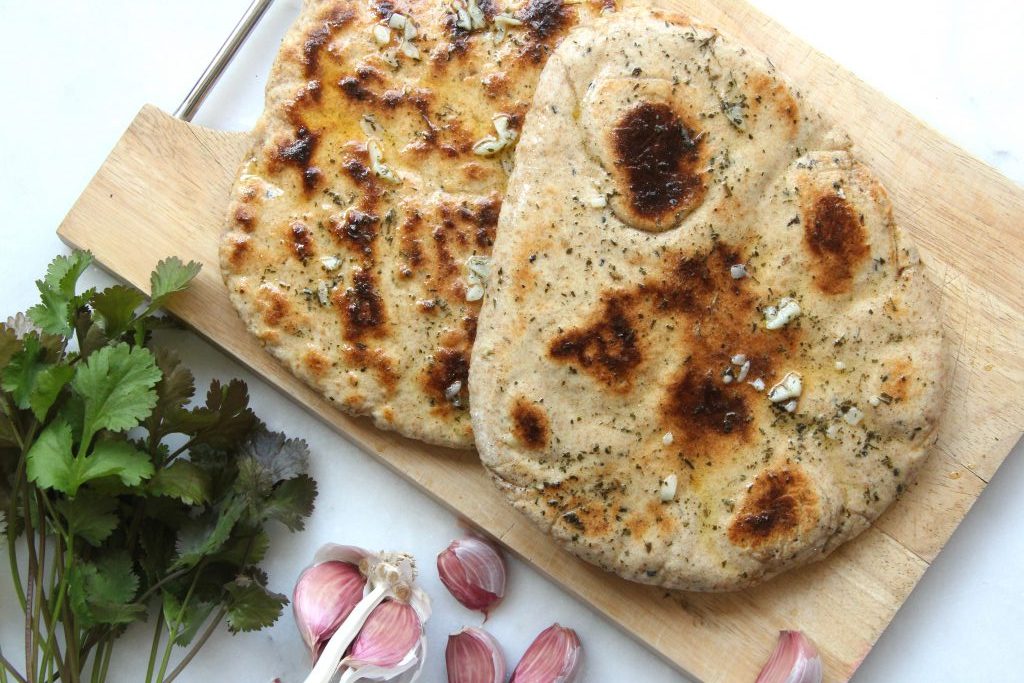
I always seem to have too much kefir, and never enough when I actually want to use it for my breakfast! If, like me, you seem to be making a lot of kefir for it to go too sour for your taste, don’t be fooled into throwing it away. That really upset me at first, when I didn’t understand my grains and fermenting. But I have now solved my kefir overflow problem – flat breads.
These are so easy to make, and taste so delicious you would never know they were made with what something that people would consider throwing away.
While I’ve had a few people scrunch their noses at me when I say I use old kefir to make these, they haven’t tried them and I’m 100% sure they would change their minds as soon as they tasted them.
When kefir goes too far and splits, you get the creamy part at the top and a yellowish clear liquid at the bottom. For me this is fermented too much for me to have in my cereal as is, and rather than waste it, I carefully tip off the clear liquid by holding a spoon to the solid top part and tilting my container. Once I’ve managed to get rid of as much as I dare, I strain the top part of the kefir off through a sieve into a container, take what I want for my breakfast, and leave the rest in the fridge. The kefir grains are then return to their normal cycle of fresh milk and left on the counter.
Once I have saved up a few day’s worth of kefir leftovers, I’m ready to make my probiotic loaded flatbreads. You can scale this recipe up or down depending on how much kefir you have, and how many flatbreads you want to make. These taste best fresh out of the pan, so I would only make as many as you can comfortably eat. Simply top them with your favourite sweet or savoury toppings and enjoy. Personally I love some garlic butter melted over the top as they come out fresh from the pan.
Using wholemeal flour is a great way to increase your fibre intake. If you don’t have wholemeal flour, you can use all self raising flour, but halve the baking powder. Or use other flours such as spelt or rye to help increase fibre diversity.
Makes 3 flatbreads
Ingredients
130g kefir, slightly strained
80g self-raising flour
100g wholemeal flour, plus extra for rolling
1 tsp baking powder
1 garlic clove, crushed
10g butter
Method
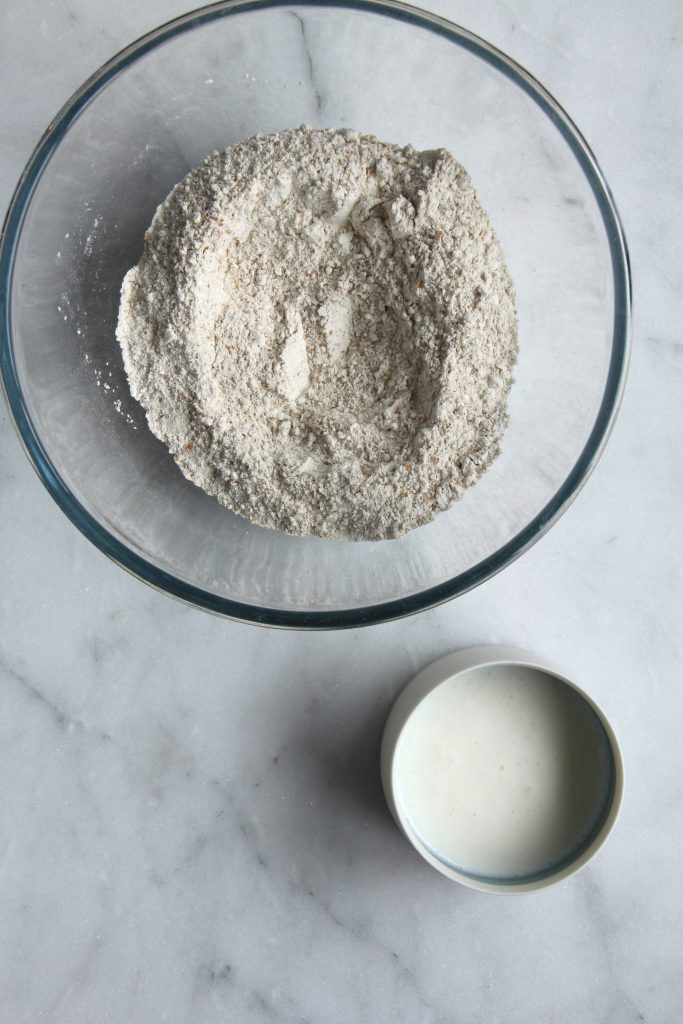
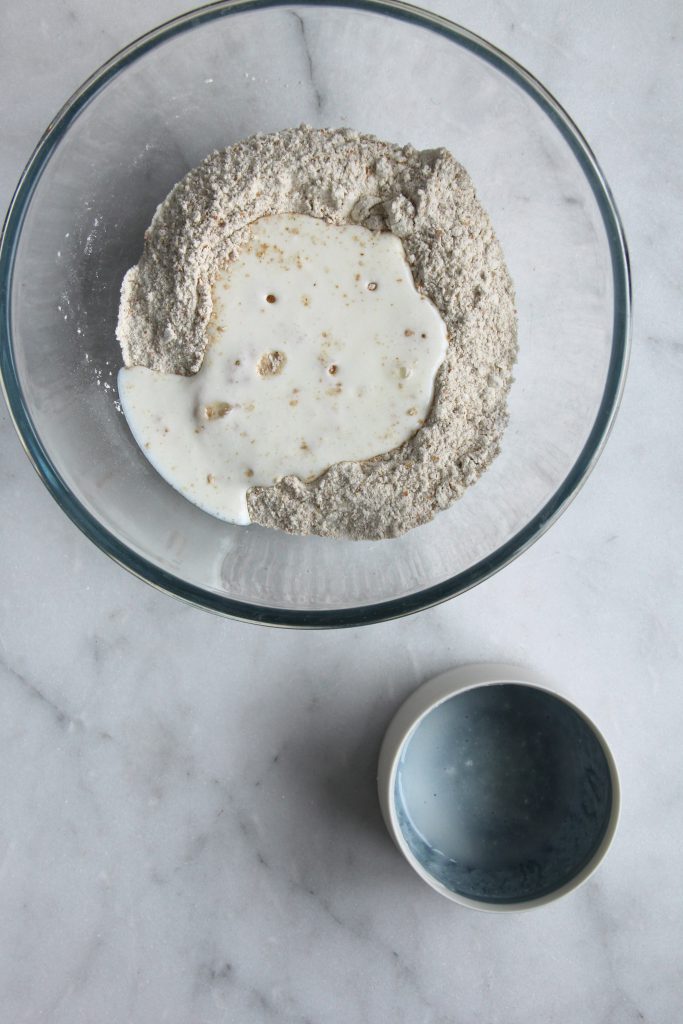
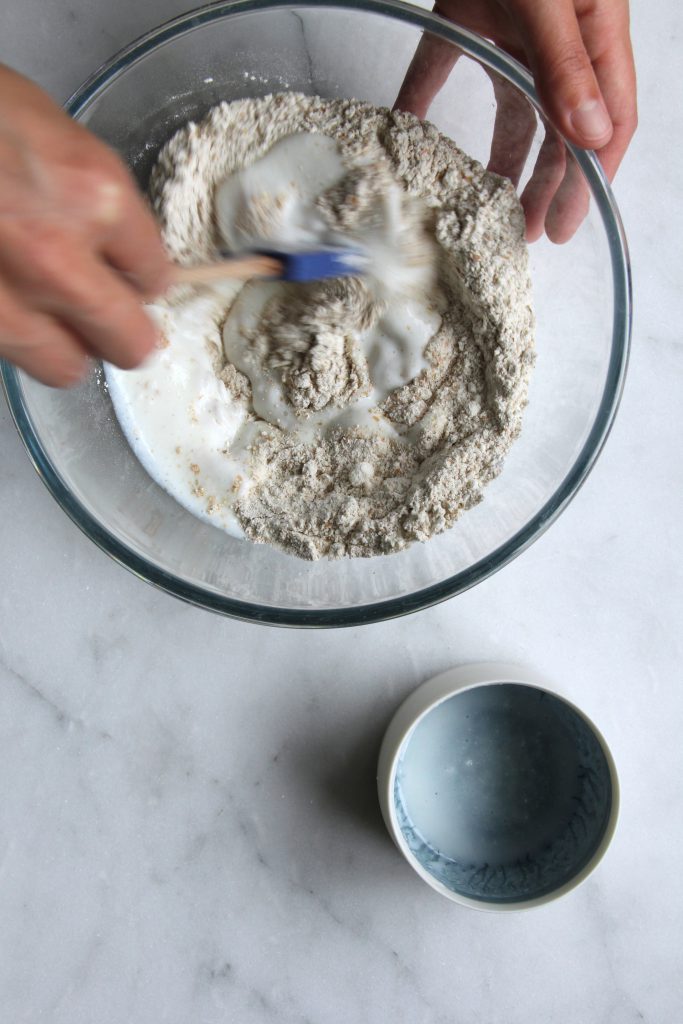
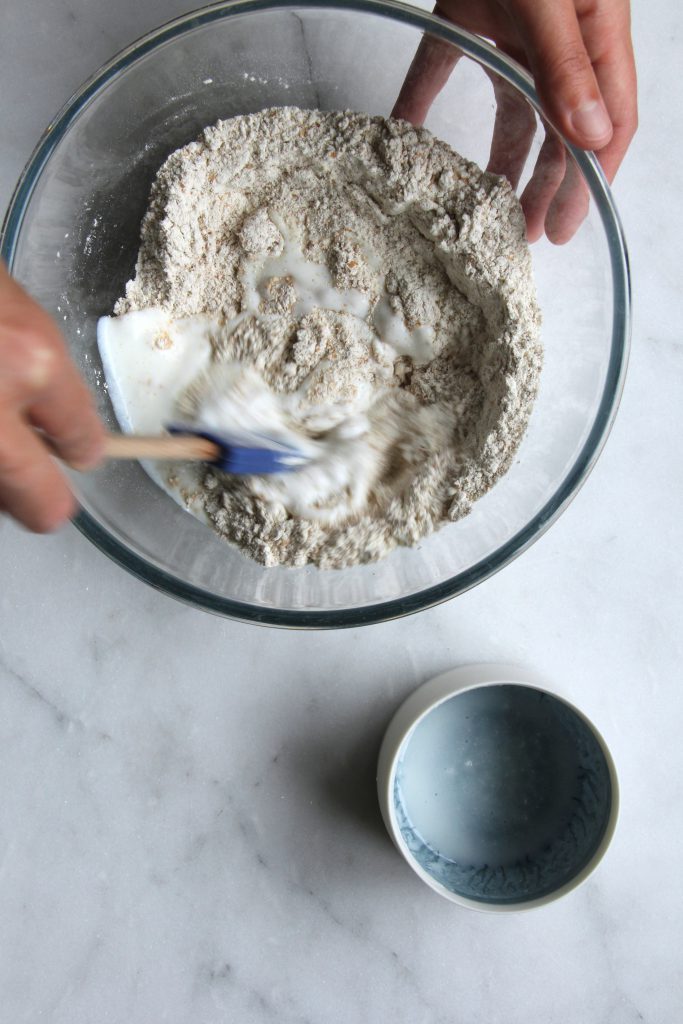
Mix all the dry ingredients together, then add the kefir. If the mixture is too sticky add a little more flour.
Knead for a few minutes till soft and smooth.
Roll out using a little flour to stop it sticking, to the thickness of a pound coin.
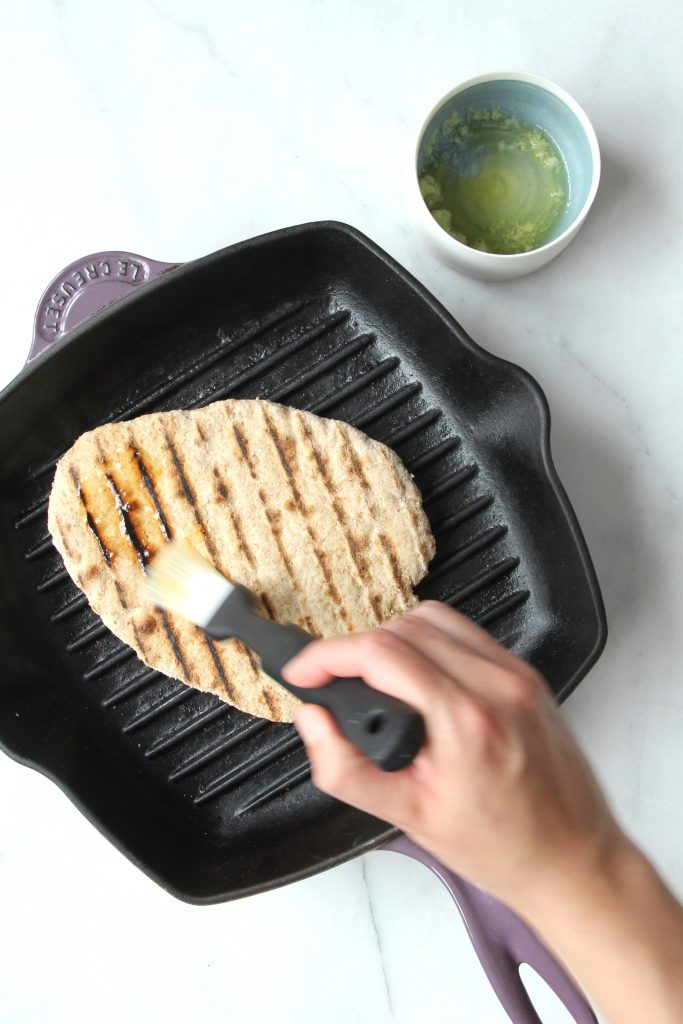
Cook in a dry pan or griddle over a medium heat for 2-3 minutes per side.
Meanwhile, gently heat the garlic and butter together till melted and the garlic fragrant.
Remove from the pan, and brush with garlic butter while hot to allow the flavorous to melt into the bread.
Per flatbread: 332kcal/ 5.2g fat/ 2.8g saturated fat/ 43.6g carbohydrates/ 4.7g fibre/ 7.4g protein










 Dr Pippa