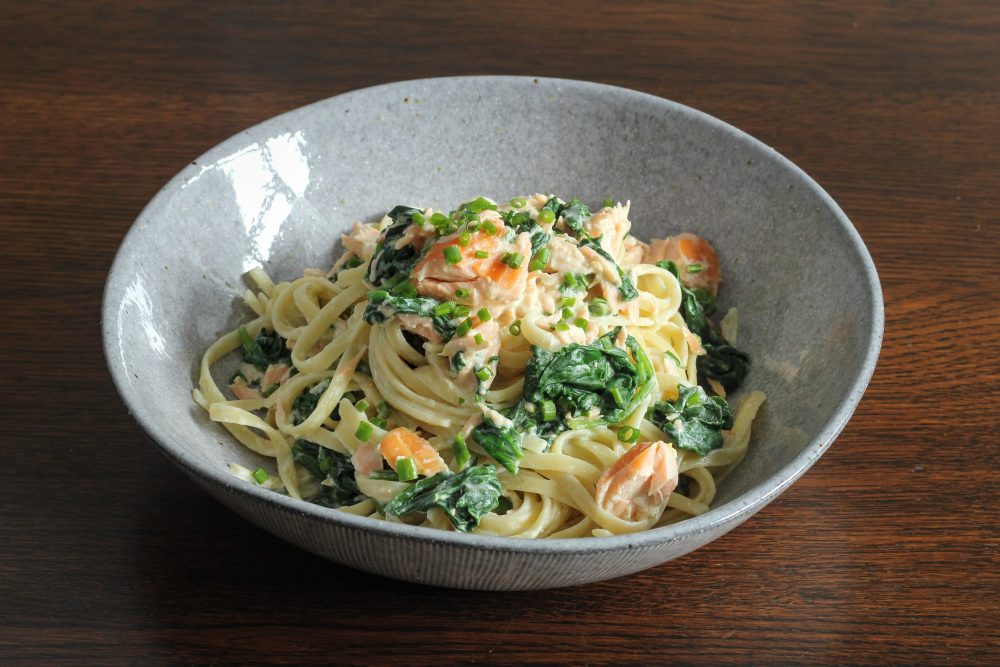
15 Minute Salmon Pasta

15 minute salmon pasta

This is the easiest bowl of comforting food you can make which is packed with beneficial nutrients such as omega-3 fats, protein, vitamins C, D, iron, folate and a portion of veg as one of you 5-a-day.

I’m using hot smoked salmon, which means I only need to cook the pasta and then stir everything together, using just one pan making it a really easy-to-make (and clean up after) meal.

Serves 2

Ingredients

  • 150g spaghetti
  • 140g baby leaf spinach
  • 80g cream cheese
  • Zest and juice of 1 lemon
  • 20g chives, finely chopped
  • 280g hot smoked salmon

Method

  • Cook the pasta for 3 minutes less than the packet instructions, saving some of the pasta cooking water before draining.
  • Over a low heat, add the spinach to the almost cooked-through pasta and allow to wilt before adding the cream cheese, lemon zest and juice, chives, smoked salmon, and season to taste with pepper. Add more pasta cooking water if needed to loosen the sauce and enjoy!
15 minute salmon pasta

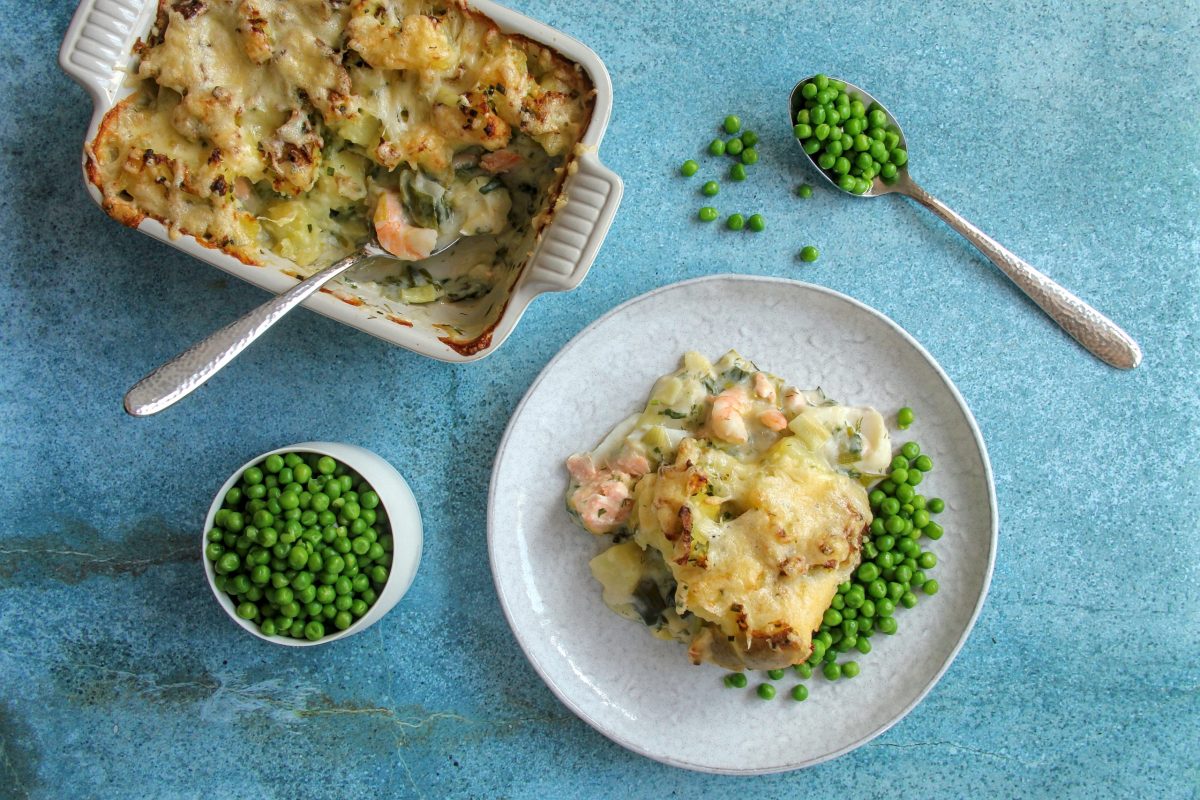
Fish Pie

I love fish pie, and it’s often something I would order when eating out. I have always thought of fish pie as a difficult dish that requires a lot of food prep.

While this isn’t my easiest recipe to make, it is not challenging at all. In fact, the most challenging part is the washing up afterwards as the full recipe requires the use of 3 pans. And I have just 3 pans at home! So for myself, it does use all the pans. You could skip poaching the fish in the milk to save washing an extra pan, and this won’t impact on the flavour too much, but it is such a simple step it really is worth doing it.

Don’t have vermouth? You can swap it out for some white wine, sherry, or replace it with an extra 50ml of milk to keep it friendly for the kids.

My Fish Pie recipe is also reasonably healthy. It contains a portion of calcium from the milk and cheese, a portion of fish (half oily too for omega 3 fatty acids), contains a mixture of vegetables and herbs for plant diversity, and doesn’t use any cream to make the sauce. Additionally, each portion of the pie, without the peas, provides over 9g of fibre thanks to leaving the skins on the potatoes.

I’m serving my fish pie with peas. You can add the peas into the sauce and bake them in the pie, but I found they got overcooked and lost their gorgeous vibrant green colour. Additionally, you could opt to serve with any other vegetable of your choice, for example, seasonal Spring asparagus, Winter Broccoli or even a salad in the summer months.

If you make this pie in advance and bake it from cold, be sure to add on an extra 5-10 minutes to ensure it gets cooked all the way through, especially if you are using raw prawns. The layer of smashed potatoes on the top are fantastic at insulating the middle section of the pie so it just needs a little extra time in the oven to ensure it is piping hot throughout.

Serve 4 adults

Ingredients

  • 900g potatoes, scrubbed and cut into 1-inch cubes
  • 2 fillets of salmon, skinned and boned
  • 2 fillets of smoked haddock, skinned and boned
  • 400ml semi-skimmed milk
  • 50ml Vermouth
  • 1 onion, cut in half through the root
  • 6 cloves
  • 3 bay leaves
  • 1 large or two small leeks, approximately 300g, sliced
  • 65g butter
  • 50g plain flour
  • 10g dill, chopped
  • 15g flat-leaf parsley, chopped
  • 100g raw prawns, deveined
  • 15g chives, chopped
  • 60g cheddar cheese, grated (optional)

To serve

  • Peas

Method

  • Preheat the oven to 180°C fan/200°C convection
  • Bring a large pan of water to the boil and cook the potatoes for 20 minutes till almost cooked through.
  • Meanwhile, poach the fish in the milk with the bay leaves and half an onion studded with the cloves. Bring to the boil and then turn the heat off. Cover with a lid and allow to poach for 5 minutes.
  • In a separate plan gently cook the remaining half of onion, finely sliced, and leeks with 40g of the butter over a low heat till soft.
  • Stir in the flour and cook for 1 minute.
  • Remove the fish from the pan and break into large chunks in an ovenproof dish, reserving the milk.
  • Pour a quarter of the milk into the leeks and stir till thick. Keep adding the milk to make the sauce.
  • Add the parsley and dill to the sauce before pouring over the fish. Top with the prawns.
  • Drain the potatoes, and lightly smash with the remaining butter. Add the chives and then top the pie.
  • Top the pie with cheese and bake in the oven for 25-30 minutes till golden brown on the top and bubbling.
  • Serve with the peas on the side.

Per portion of pie: 569kcal/ 33.1g fat/ 14.5g saturated fat/ 64.8g carbohydrates/ 9.1g fibre/ 48.3g protein

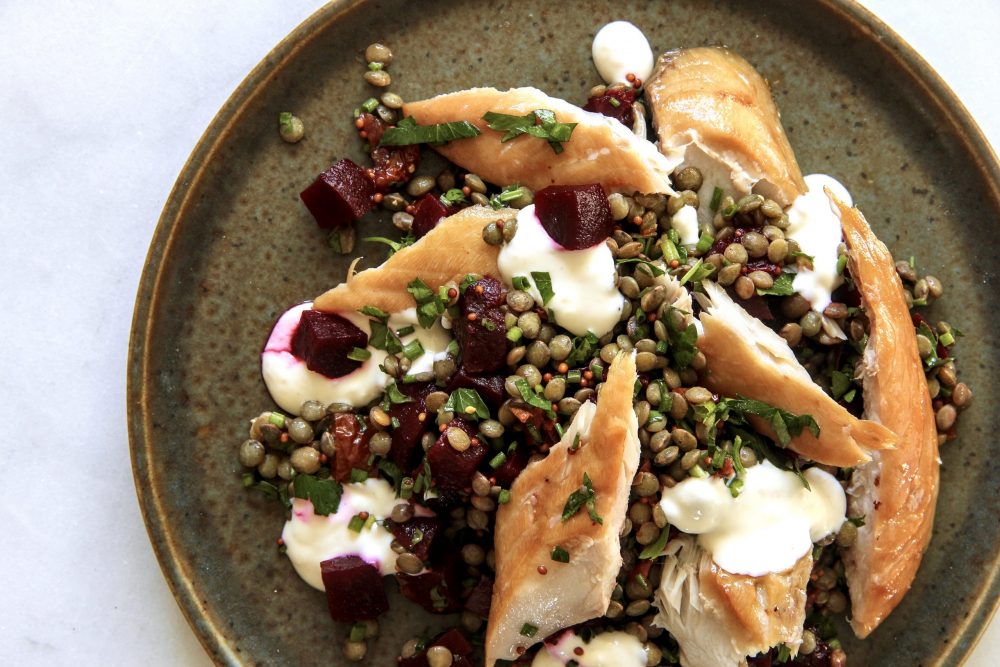
Smoked Mackerel, Lentil and Horseradish Salad

Getting oily fish in can be a challenge, and during lockdown I find it harder to get fresh fish weekly so I’ve been eating more smoked fish due to the increased shelf life. While I don’t plan on carrying this on beyond lockdown, and rather used smoked fish as a treat rather than a source of omega-3 fatty acids, for the while they have ended up as a partial staple in my lockdown diet. Here’s the lowdown on omega-3 fatty acids.

Omega-3 fatty acids area type of polyunsaturated fatty acid. These fats can’t be made in our bodies, so we rely on dietary sources instead. There are a few different forms of omega-3 fats, including eicosapentaenoic acid (EPA), docosahexaenoic acid (DHA) and alpha-linolenic acid (ALA).

Dietary sources of EPA and DHA include oily fish such as salmon, mackerel, kipper, herring, sardines and fresh tuna (but not tinned tuna); shellfish; and seaweed (but eating this more than once per week may provide too much iodine). Alternatively you can find EPA and DHA in omega-3 fortified products such as: dairy and dairy alternative products, eggs; and supplements.

ALA can be converted to EPA and DHA in our body, but this isn’t always converted in significant amounts, especially in relation to DHA, so there are less health benefits associated with consuming ALA. Dietary sources of ALA include seeds such as chia seeds, linseeds, hemp seeds (and hemp seed oil), walnuts (and walnut oil), pecans, hazelnuts; products derived from soybeans like soybean oil and tofu; rapeseed oil; green leafy vegetables and ALA supplements.

We should be aiming to eat 2 portions of fish a week, with at least 1 portion to be oily, with the upper limit set at 4 portions of oily fish per week due to pollutants being present in some fish which could build up in our bodies. Separately, women of childbearing age, pregnant or breastfeeding women should limit their intakes to two portions per week.

Using lots of store cupboard ingredients here, you could swap the fresh herbs out and use salad leaves, or use kale as an alternative vegetable. If you are really struggling to get fresh salad, or making this when you have run out of fresh foods opt for some frozen vegetables such as edamame beans or peppers. And for those who need a super quick lunch, this dish can be made in 2 minutes by using a pouch of ready-cooked lentils. Simply heat the lentils up and dress them with the herbs and spices and you’re good to go!

Serves 2

Ingredients

  • 100g puy lentils
  • 10g wholegrain mustard
  • 40g sundried tomatoes, finely chopped
  • 10g chives, chopped
  • 15g flat-leaf parsley, chopped
  • 120g pickled beetroot, finely cubed
  • 10g horseradish sauce
  • 50g reduced-fat creme fraiche
  • 2 fillets of smoked mackerel

Method

  • Place the lentils in a saucepan and cover with plenty of cold water. Bring to the boil and simmer for 12 minutes.
  • Once the lentils have cooked, drain and dress with the mustard and tomatoes whilst still hot. Allow to cool for 2 minutes before adding in the herbs.
  • Separately mix the horseradish and creme fraiche together.
  • Add the beetroot to the lentils and combine before plating up with the mackerel and horseradish sauce.

Per serving: 487kcal/ 28.6g fat/ 8.5g saturated fat/ 23.0g carbohydrates/ 12.9g fibre/ 28.2g protein